Physical Address
304 North Cardinal St.
Dorchester Center, MA 02124
Physical Address
304 North Cardinal St.
Dorchester Center, MA 02124


Paul Brown,
Kayleen Devlin,
Ervan Rivo and
Barbara MetzlerBBC Check
 Getty Images
As thousands of Gazans returned to their neighborhoods after the ceasefire, many already knew their homes were in ruins.
The prospect of rebuilding homes, businesses and all the institutions and services needed to return to normal life in Gaza is daunting by any measure: the UN estimates that damages totaled $70 billion.
As Professor Andreas Krieg, a Middle East security expert at King’s College London, says: “It’s worse than starting from scratch – here you’re not starting from the sand, you’re starting from the rubble.”
The level of destruction in the Strip is “now in the region of 84%. In some parts of Gaza, such as Gaza City, it is even up to 92%,” said Jaco Cilliers, the UN Development Program’s special representative for the Palestinians.
This damage created colossal amounts of debris. BBC Verify estimates, based on recent satellite data, suggest that there may be over 60 million tonnes of debris in Gaza waiting to be cleared.
Any post-conflict reconstruction process must begin with clearing the remnants of war.
The many millions of tons of debris now littering the Gaza Strip are not just piles of concrete and twisted metal. They also contain human remains and unexploded bombs.
“From a safety and humanitarian point of view, the first thing you have to do is make the sites that have been bombed safe,” says former JCB chief executive Philippe Bouvera.
A process of sorting, separating and crushing the debris follows. After removing materials such as plastic and steel, the remaining concrete can be ground up and reused.
This will lay the foundation for construction, but the construction effort will require massive imports of materials.
“It’s not going to happen with trucks crossing the border. The first thing we need to do is build a deep-sea port because then you can bring in thousands of containerized cargo,” added Mr Bouvera.
When the sites are cleared, then basic services such as water, sewage and electricity can be restored, he says.
Clean water is a major immediate need for Gazans. According to Unicef estimates, more than 70% of the territory’s 600 water and sanitation facilities have been damaged or destroyed as of October 7, 2023.
Following the recent announcement of a ceasefire, Israeli soldiers pose in front of a waste water treatment plant in Gaza City that was set on fire. The damage occurred just before the Israeli army withdrew from a position near this infrastructure.
Wastewater treatment is critical to preventing the accumulation of sewage and the spread of disease. Doctors said Gaza has high rates of diarrheal diseases that can kill children and a risk of cholera in some areas.
In satellite images, you can see damage to the bio-towers of the Sheikh Ejleen Wastewater Treatment Plant, which are the main components used to treat waste water.
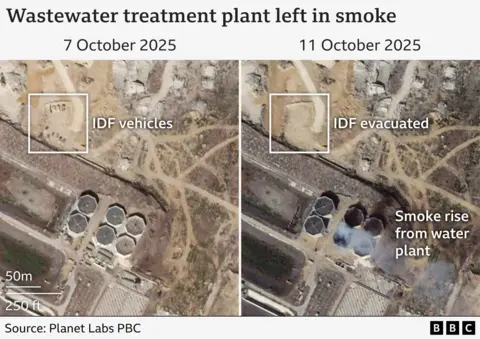
There are six sewage treatment plants in Gaza. “They are all damaged,” said Maher Najjar, deputy director of the Coastal Municipalities Water Supply Company (CMWU), which oversees and manages repairs to Gaza’s water infrastructure.
Since the start of the war, repairs have been severely hampered by the imminent danger of Israeli air and artillery attacks and a shortage of tools, he said. Some facilities have been attacked again after being repaired.
The IDF said its actions were “based on military necessity and in accordance with international law” as it sought to prevent Hamas from “threatening the citizens of Israel”.
In addition to facilities that treat sewage, Gaza has separate facilities that provide clean drinking water that have also suffered extensive damage.
Satellite images from April 2024 show a seawater desalination plant that supplies northern Gaza and Gaza City still intact. But by the beginning of May, it was destroyed.
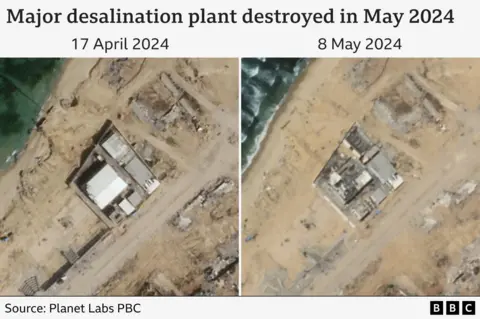
“We are talking about damaged water wells, damaged networks, reservoirs, transmission lines. It is very difficult to know where to start. To begin with, we need at least $50 million to restore about 20% of services to the population,” said Mr. Najjar.
“The total loss is about $1 billion, maybe more.”
Satellite images show the devastation in the area of Sheikh Radwan, a neighborhood in the northeast of Gaza City.
In August, before the IDF occupied the city it called Hamas’ “last stronghold,” many streets appeared largely intact. By last week, entire sections of the neighborhood had been leveled as the IDF set up a base.
During the war, the UN satellite center Unosat estimates that a total of 282,904 houses and apartments in Gaza were damaged or destroyed.
But these figures are likely underestimates, as they do not yet include recent military operations in Gaza City, such as the destruction in Sheikh Radwan.
The graph below shows how the rate of residential damage increased sharply in mid-2024 – coinciding with IDF operations in Rafah that left much of the city in ruins. Another significant spike probably occurred as a result of the occupation of Gaza City.
The Hamas-run Gaza City Municipality reported that 90 percent of roads were also damaged.
According to Shelley Culbertson, a senior policy researcher at the Washington-based think tank RAND Corporation, rebuilding housing in Gaza “could take decades.”
“After Israel’s bombing of Gaza in 2014 and 2021, housing reconstruction was slow because Israel did not allow many building materials because they had a dual purpose,” she said.
“If you restore now the way they did in 2014 and 2021, it will take 80 years. If there is good planning, it could take less time,” she said.
“Good planning is designing camps that can become neighborhoods and helping people move back and rebuild damaged homes.”
Gaza’s power system was under strain before the current war. Permanent blackouts were common and most Gazans lived with limited hours of electricity each day.
Historically, most of Gaza’s electricity supply comes from power lines connecting it to Israel and the diesel-powered Gaza Power Plant, with some solar panels added on rooftops and public facilities in recent years.
As of October 11, 2023, Gaza experienced a near total blackout after Israel cut off external electricity. One exception was a direct feed to the southern Gaza desalination plant, which supplies clean drinking water. Israel reconnected power to this plant on November 14, 2024, and then cut it again on March 9, 2025, before reconnecting it again.
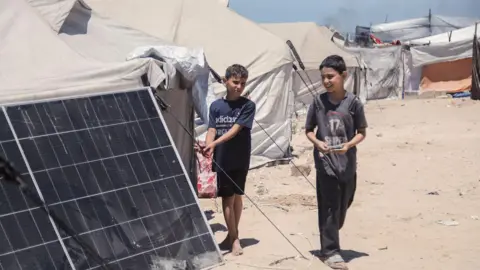
The Gaza power plant is out of operation due to lack of fuel, and the solar facilities have suffered extensive damage.
With the grid almost down, essential services depend on a limited number of diesel generators and remaining solar panels.
 Getty Images
A joint assessment earlier this year by the World Bank, the European Union and the United Nations estimated that more than 80 percent of electricity generation and distribution assets have either been destroyed or are out of service since the start of the war, with an estimated damage value of more than $494 million.
Gaza Electricity Distribution Cooperation (Gedco), the company responsible for managing the electricity supply in the Gaza Strip, says that 70% of its buildings and facilities have been destroyed since October 2023.
At the end of last month, we checked a video of the attack on the company’s headquarters.
In a statement after the event, Gedco said the attack had “directly affected the company’s ability to run its administrative and technical business”.
The satellite image below of an area east of Jabalia shows how 4 sq km of crops – probably olive and citrus trees – were destroyed during the war.
A road or runway created by the IDF runs through the leveled land, presumably to provide access to the northern areas of nearby Gaza City.
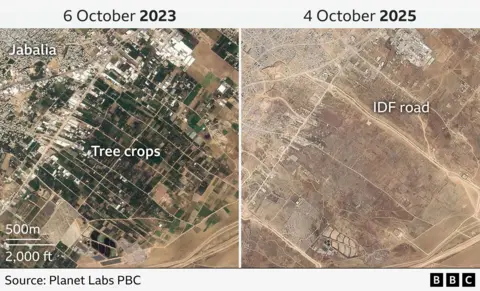
Analysis by Prof. He Yin of Kent State University found that in the Gaza Strip, 82.4% of annual crops and more than 97% of tree crops were likely to have suffered damage during the war by August 10 this year.
The decline of agriculture, combined with continued restrictions on aid, led to severe food insecurity during the conflict, culminating in a declaration of famine in Gaza City in September.
Unosat attributed this decline to “the impact of activities such as demolition, heavy vehicle activity, bombing, shelling and other conflict-related dynamics.”
Mr Bouvera says that to restore agriculture, the land must be cleared of unexploded bombs, shells and mines “quite urgently”. “If they can grow their own crops, they can feed themselves, and the sooner we do that, the better,” he says.
About half of Gaza’s pre-war population was under the age of 18, so rebuilding schools is essential to any return to normal life.
The school buildings became shelters for displaced Palestinians during the conflict and were often targeted by IDF forces under the pretext that they housed “command and control” centers for Hamas and its affiliated groups.
The United Nations Relief and Works Agency for Palestine, Unrwa, which once ran 288 schools in Gaza, says 91.8 percent of all school buildings will need “complete reconstruction or major rehabilitation to be functional again.”
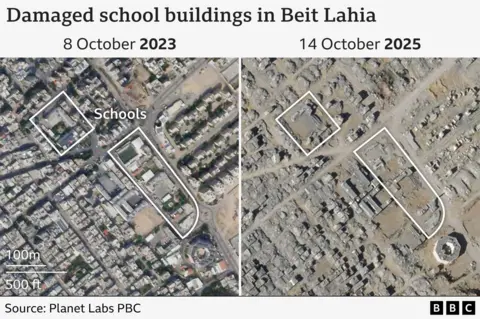
Higher education institutions are not spared either.
For example, in December 2023, Al-Azhar University south of Gaza City was blown up by Israeli troops. The site is now part of the Netzarim Corridor, one of several militarized zones established by the IDF over the course of the war.
The same fate befell Israa University less than 2 kilometers away. which was destroyed by IDF troops after serving as a temporary base for several weeks.