Physical Address
304 North Cardinal St.
Dorchester Center, MA 02124
Physical Address
304 North Cardinal St.
Dorchester Center, MA 02124

 Tim WellHost of People’s History of Gaza
 The BBC
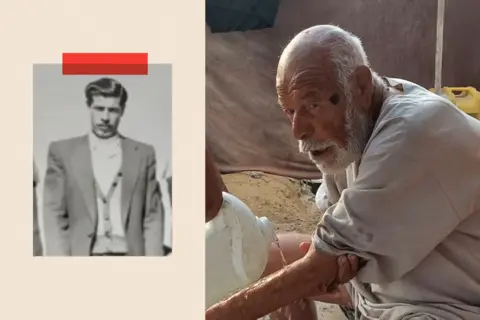
“I was riding a camel with my grandmother on a sandy road and I started crying.” Ayish Younis describes the worst moment of his life – he still considers it as such, even though it was 77 years ago and he has experienced many horrors since then.
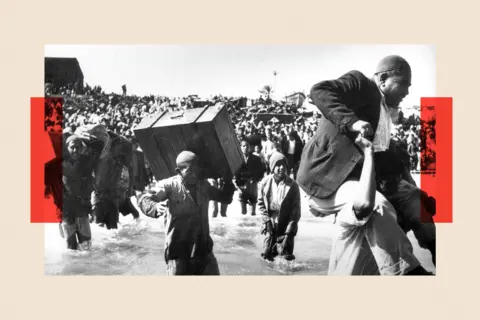
It was 1948, the first Arab-Israeli war was raging, and Ayish was 12. He and his entire extended family were fleeing their homes in the village of Barbara – famous for grapes, wheat, corn and barley – in what was once British-ruled Palestine.
“We were scared for our lives,” Ayish says. “We didn’t have the means to fight the Jews ourselves, so we all started leaving.”
 Ahmed Younis Family Archive/BBC
The camel took Ayish and his grandmother seven miles south of Barbara, to an area controlled by Egypt that would become known as the Gaza Strip. It was only 25 miles long and a few miles wide and had just been occupied by Egyptian forces.
In total, about 700,000 Palestinians lost their homes and became refugees as a result of the 1948-49 war; An estimated 200,000 were crammed into this small coastal corridor.
“We had pieces of wood that we propped up against the walls of a building to make a shelter,” Ayish says.
They were later moved to one of the huge tent camps set up by the UN.
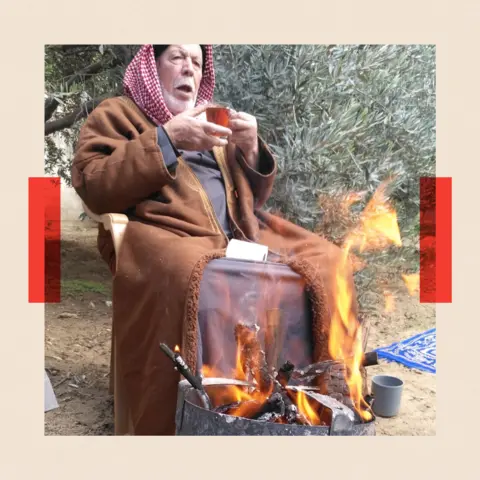
Today, at the age of 89, Ayish is once again living in a tent in Al-Mawasi near Khan Yunis.
In May last year, seven months into the two-year war between Israel and Hamas, Ayish was forced to leave his home in the southern Gaza town of Rafah following an evacuation order from the Israeli military.
The four-story house, divided into several apartments, which he shared with his children and their families, was destroyed by what he said may have been Israeli tank fire.
Home is now a small white canvas tent just a few meters away.
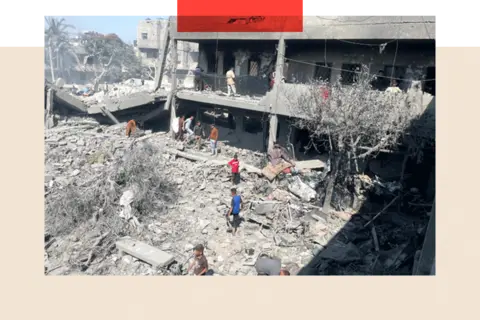
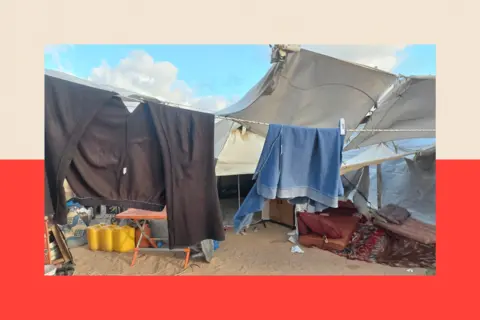
Other family members are in neighboring tents. They all had to cook over an open fire. Without access to running water, they wash themselves with water from cans, which is scarce and, as a result, expensive.
“We’re back to where we started, we’re back in the tents, and we still don’t know how long we’ll be here,” he says, sitting on a plastic chair on the bare sand outside his tent, clothes drying on a clothesline nearby.
A walking frame is propped up next to him as he struggles to move. But he still speaks the crystal-clear, melodious Arabic of a man who has studied literature and recited the Koran daily as the imam of a local mosque.
“After we left Barbara and lived in a tent, we eventually managed to build a house. But now the situation is more than a disaster. I don’t know what the future holds and if we will ever be able to build our house again.”
“And finally I just want to go back to Barbara, with all my extended family, and taste the fruits I remember from there again.”
On October 9, Israel and Hamas agreed to the first phase of a ceasefire and hostage release agreement. The remaining 20 hostages held by Hamas were returned to Israel and Israel released nearly 2,000 Palestinian detainees and prisoners.
Yet despite the widespread rejoicing over the ceasefire, Ayish is not optimistic about the long-term prospects for Gaza.
“I hope that peace will spread and it will be peaceful,” he says. But I believe the Israelis will do what they want.
Under the agreement for the first phase of the ceasefire, Israel will retain control of more than half of the Gaza Strip, including Rafah.
One question Ayish, his family and all Gazans ponder is whether their homeland will ever be successfully rebuilt.
In 1948, the Egyptian army was one of five Arab armies that invaded the British-controlled territory of Mandatory Palestine the day after the creation of the Jewish state, Israel. But they soon retreat, defeated, by Barbara, prompting Ayish’s decision to flee.
Ayish became a teacher when he was 19 and earned a degree in literature in Cairo on a scholarship program.
The best moment of his life, he says, was when he married his wife, Khadijah. Together they had 18 children. This, according to a newspaper article that once introduced him, is a record – the largest number of children from the same mother and father in any Palestinian family.
Today, he has 79 grandchildren, two of whom were born in the last few months.
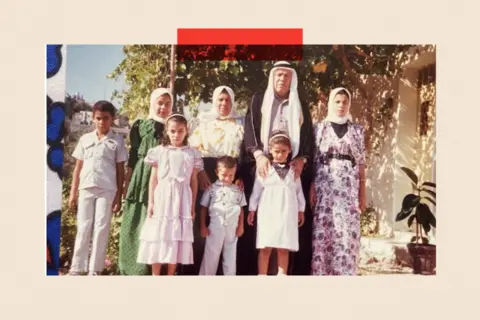 Ahmed Younis Family Archive
The family would move from their first tent to a simple three-room cement house with an asbestos roof in the refugee camp, which they later expanded to nine rooms – thanks in part to wages earned in Israel.
When the border between Israel and Gaza opened, Ayish’s eldest son Ahmed was one of the many Palestinians who took advantage, working in an Israeli restaurant during his vacations while studying medicine in Egypt.
“During that time in Israel, people were getting paid very well. And that’s the time period when the Palestinians made most of their money,” he says.
All but one of Ayish’s children have earned university degrees. They became engineers, nurses, teachers. A few moved abroad. Five are in Gulf countries and Ahmed, a spinal cord injury specialist, now lives in London. Many other families in Gaza are similarly dispersed.
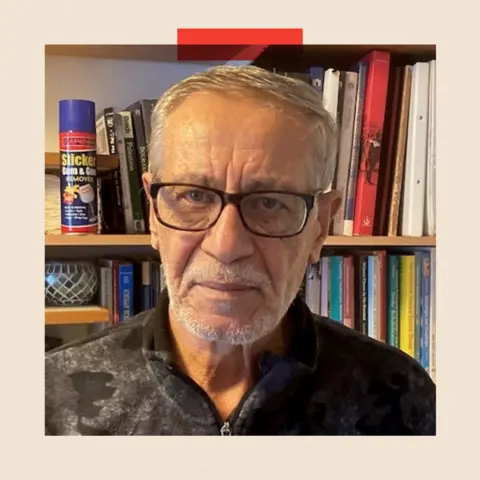
The Younis family, like many Gazans, wanted nothing to do with politics. Ayish became an imam at a mosque in Rafah – and a local chief (or mukhtar) responsible for settling disputes, just as his uncle had been years earlier in the village of Barbara.
He was not appointed by the government, but says he was respected by both Hamas and the Fatah political movement, the dominant party in the Palestinian Authority.
However, this did not save the family from tragedy during the street battles of 2007, when Fatah and Hamas fought for control of the Strip. Ayish Fadua’s daughter was killed in crossfire while she was sitting in a car.
The rest of the family survived the wars between Hamas and Israel in 2008, 2012, 2014 – as well as the devastating war sparked by Hamas’ deadly attack on Israel on October 7, 2023.
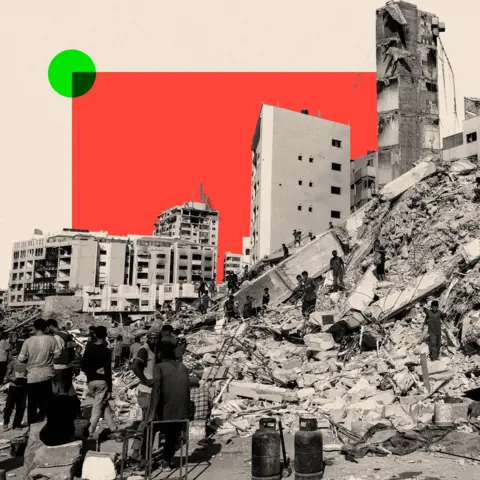
Then came the evacuation order from the Israeli military, which said it was conducting operations against Hamas in the area, forcing them out of their home in Rafah and more than a year spent in makeshift tents.
Ayish’s life has come full circle since 1948. But his greatest wish is to go back even further in time, to return to the village, now in Israel, that he last saw when he was 12 – even though it no longer exists.
Apart from clothes, cookware and a few other essentials, the only possessions he carries with him in his tent are the precious title deeds to his ancestral land in Barbara.
Now thoughts are turning to the reconstruction of Gaza.
But Ayish believes the extent of the destruction – of infrastructure, schools and health services – is so great that it cannot be fully repaired, even with the help of the international community.
“I don’t believe Gaza has a future,” he says.
He believes his grandchildren could play a role in rebuilding Gaza if the truce is fully implemented, but he does not believe they will be able to find as good a job in the territory as those they have or could find abroad.
His son Haritha, a graduate in Arabic, has four daughters and one son, also lives in a tent. “An entire generation was destroyed by this war.
“We are unable to understand it,” he says.
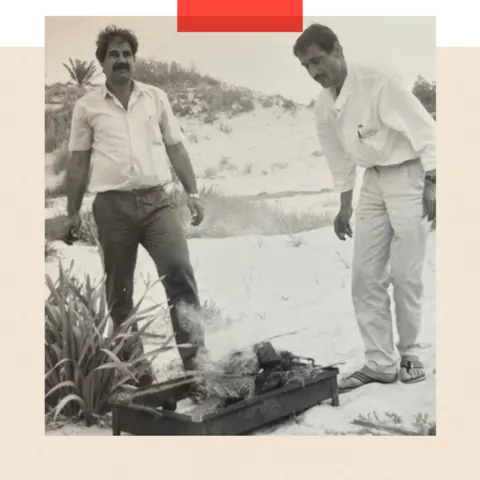 Ahmed Younis Family Archive
“We heard from our fathers and grandfathers about the 1948 war and how difficult it was to evacuate, but there is no comparison between 1948 and what happened in that war.
“We hope that our children will play a role in rebuilding, but as Palestinians, do we have the capacity to rebuild the schools ourselves? Will donor countries play a role in that?”
“My daughter went through two years of war without school, and two years before that schools were closed because of Covid,” he continues. “I used to work in a clothing store, but it was destroyed.
“We don’t know how things are going to play out or how we’re going to have a source of income. There are so many questions we don’t have answers to. We just don’t know what the future holds.”
Another of Ayish’s sons, Nizar, a trained nurse who lives in a tent nearby, agrees. He believes that Gaza’s problems are so great that the youngest generation of the family will not be able to play a big role, despite their high level of education.
“The situation is unbearable,” he says. “We hope that life will return to the way it was before the war. But the destruction is massive – total destruction of buildings and infrastructure, psychological devastation in the community and destruction of universities.”
 Getty Images
Meanwhile, Ayish’s eldest son, Ahmed, in London, reflects on how it took the family more than 30 years to build their former home into what it eventually became – as money was saved over the years, it was extended, he explains.
“Do I have another 30 years to work and try to help and support my family? That’s really the case all the time — every 10 to 15 years people lose everything and they’re back to square one.”
And yet he still dreams of living in Rafah again when he retires. “My brothers in the Persian Gulf bought land in Rafah to come back and settle as well. My son, my nieces and nephews – they want to come back.”
With a pause, he adds: “I’m very optimistic by nature because I know how determined our people in Gaza are. Trust me, they will come back and start rebuilding their lives.”
“Hope is always in the new generation to rebuild.”
Best Photo Credit: AFP via Getty Images

BBC InDepth is the home of the best analysis website and app, with fresh, thought-provoking perspectives and in-depth reporting on the biggest issues of the day. You can now sign up for notifications that will alert you whenever an InDepth story is published – click here to find out how.