Physical Address
304 North Cardinal St.
Dorchester Center, MA 02124
Physical Address
304 North Cardinal St.
Dorchester Center, MA 02124

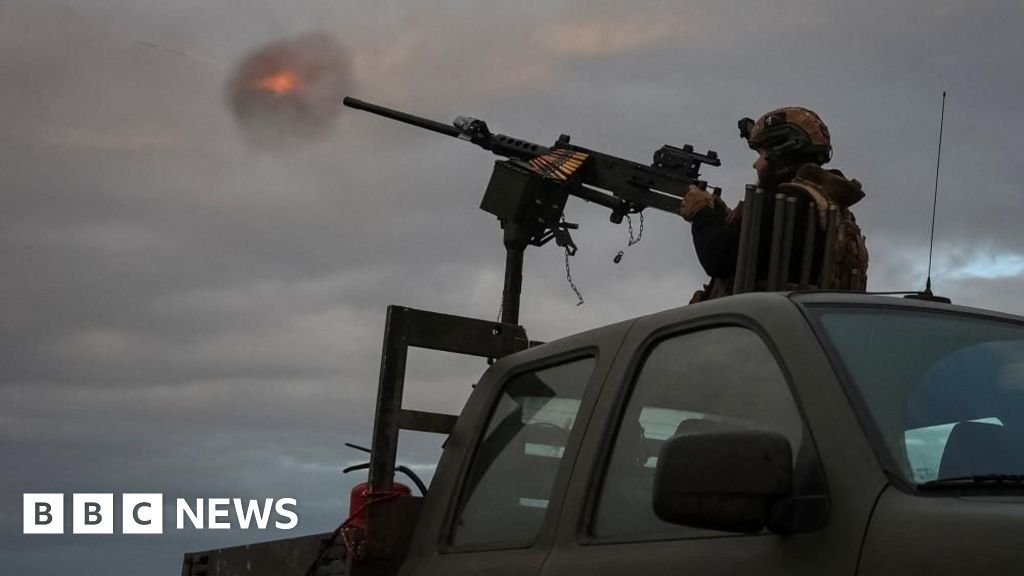
European leaders have joined Ukraine’s Volodymyr Zelensky in insisting that any talks to end the war in Ukraine must begin with a freeze on the current front line and warned that Russia is not serious about peace.
In a statement signed by 11 leaders, including UK Prime Minister Keir Starmer, they said they “strongly support” US President Donald Trump’s position that “the fighting must stop immediately and that the current line of contact must be the starting point for negotiations”.
But Russian Foreign Minister Sergei Lavrov on Tuesday rejected the idea of stopping the conflict on the current line of contact.
Moscow is only interested in “long-term, sustainable peace,” Lavrov said, implying that a frontline freeze would only mean a temporary ceasefire.
The European Statement mentioned Russia’s “delay tactics”which shows how intractable Moscow’s position remains.
Trump, who has often taken a conciliatory tone toward Russia, is now planning direct talks with Putin in Budapest – although the date for a preparatory meeting between US Secretary of State Marco Rubio and Lavrov appears to be slipping away.
The US president spoke by phone with Putin last week, a day before he met with Zelensky and his team at the White House.
Several sources have told Western media that Trump has pushed the Ukrainian leader to give up large swaths of territory in the eastern regions of Donetsk and Luhansk, known as the Donbass, as part of a deal with Russia.
Some reports suggest there was a “shouting match”. Zelensky only described the talks as “frank”.
The Ukrainian president has often ruled out withdrawing from the region, arguing that Russia could use it as a springboard for future attacks. “I explained during my visit to Washington last week that Ukraine’s position has not changed,” he said on Monday.
Although Russia has occupied most of Luhansk, Ukraine continues to control about a quarter of Donetsk, including the key cities of Slavyansk and Kramatorsk.
Trump, who later denied ever pushing Zelensky to hand over Donbass, has since embraced the idea of a ceasefire on the current front lines.
“Let it be cut as it is,” he said Monday, referring to the contested region.
“It’s cut right now. I think 78% of the land has already been taken by Russia… I said cut and stop on the battle line. Go home. Stop fighting, stop killing people.”
But Moscow continues to reject talk of a frontline freeze.
Kremlin spokesman Dmitry Peskov said the idea had been put to the Russians repeatedly, but that “the consistency of Russia’s position does not change” – referring to Moscow’s insistence on the full withdrawal of Ukrainian troops from the tense eastern regions.
Foreign Minister Sergey Lavrov repeated almost the same lines on Tuesday.
The “root causes of the conflict” must be addressed, Lavrov said, using Kremlin shorthand for a series of maximalist demands that include recognizing Russia’s full sovereignty over the Donbass as well as the demilitarization of Ukraine – a non-starter for Kiev and its European partners.
The Kremlin downplayed expectations of an upcoming meeting between Putin and Trump. “We cannot postpone what is not finalized,” Peskov said.
Lavrov and US Secretary of State Marco Rubio were due to meet this week to arrange the meeting, but no times have yet been given.
A potential meeting between Trump and Putin in Hungary would require at least one EU country to open its airspace to the Russian leader’s plane.
Putin is the subject of an international arrest warrant for war crimes, and Poland and Lithuania have already signaled they would execute it if he travels through their countries.
Another route to Budapest for Putin will be through Bulgarian airspace. Foreign Minister Georg Georgiev hinted that Bulgaria is ready to miss the plane.
“When there is an effort for peace, it is only logical that all parties should contribute to make such a meeting possible,” he said.
Trump and Putin last met in Alaska in August during a hastily arranged summit that produced little other than ending Putin’s status as a Western pariah.
Some time after the negotiations, Trump put forward the idea of organizing a Putin-Zelensky bilateral meeting summit meeting.
But Russia said such a meeting depended first on the “root causes” of the war, and the idea was eventually quietly rejected by all sides.
Since the beginning of his second term in office, Trump has complained that the Russian-Ukrainian war, now in its fourth year, is “difficult” to resolve.


