Physical Address
304 North Cardinal St.
Dorchester Center, MA 02124
Physical Address
304 North Cardinal St.
Dorchester Center, MA 02124

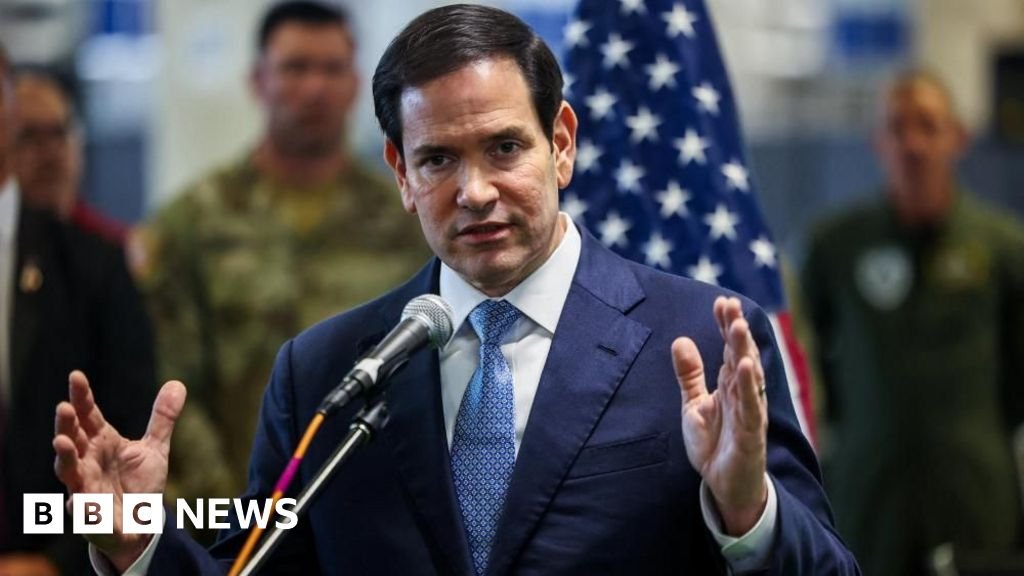
US Secretary of State Marco Rubio said “many countries” have offered to be part of an international security force for Gaza – a key part of President Donald Trump’s peace plan – but added that Israel must be comfortable with the participants.
Speaking during a visit to Israel, Rubio said that negotiations to form the International Stabilization Force (ISF) were ongoing and that it would come into force “as soon as possible”.
However, it remained unclear how such a force could be deployed without an understanding with Hamas.
He said the ceasefire between Israel and Hamas had made “historic” progress since it began two weeks ago, but warned to expect “ups and downs, twists and turns”.
“There is no plan B,” he said. “It’s the best plan. It’s the only plan. And we think it can work.”
Rubio said conditions must be created “so that we never again see what happened on October 7th, so that you can actually be in a place (Gaza) where there are no longer elements operating that are a threat to Israel or to their own people for that matter.”
The war was sparked by a Hamas-led attack on Israel on October 7, 2023, in which around 1,200 people were killed and another 251 taken to Gaza as hostages.
At least 68,280 Palestinians were killed in the ensuing Israeli military campaign, according to the Hamas-run Gaza Health Ministry, whose figures are considered reliable by the United Nations.
Rubio said Hamas would be disarmed as required by Trump’s plan. “If Hamas refuses to demilitarize, that will be a violation of the agreement and that will have to be implemented,” he said.
“Hamas cannot govern and cannot participate in governing the future of Gaza,” he added.
Rubio’s visit caps a week in which senior US officials, including Vice President JD Vance, have been visiting Israel. It is a sign that Washington is determined to make Trump’s Gaza plan a success and is concerned that the actions of Israeli Prime Minister Benjamin Netanyahu’s government could derail it. In Israeli media, the effort has been described as “Bibi-sit”, a play on the prime minister’s nickname.
In recent days, multiple reports suggest the White House’s frustration with the Israeli governmentfueled by the military’s deadly response to an attack it blamed on Hamas in Gaza last weekend and a vote in Israel’s parliament to annex the occupied West Bank on Wednesday while Vance was visiting.
Israel’s Aaretz newspaper reported that US officials said they “will not tolerate any surprises from Israel that could jeopardize the ceasefire” and that they expect advance notice from Israel before any strikes on Gaza. “In practice,” the report said, “the United States (had) taken over certain security agencies from Israel.”
Publicly, Netanyahu, whose coalition relies on the support of ultranationalist ministers, has dismissed reports that Washington makes decisions on Israel’s behalf, describing the country’s relationship as one of partnership.
The apparent pressure from the country’s most important ally, at a time when Israel faces unprecedented isolation, risks derailing its strategy to present the Gaza war as a victory at home. This narrative will be essential in the campaign for the next parliamentary elections due in October 2026.
Both Rubio and Vance tried to strike a positive tone in their public statements — both said they were optimistic the truce would hold — while acknowledging that negotiations on the remaining points would be difficult and lengthy.
Those issues included the scale of Israel’s withdrawal, the future governance of Gaza and the formation of the ISF, as well as disarmament from Hamas, and they offered no indication of how those talks would proceed.
Rubio said there are “many countries” that have offered to participate in the ISF. “Obviously, when you put that force together, it’s going to have to be people that Israel is comfortable with or countries that Israel is also comfortable with,” he added, without elaborating.
That appeared to be a reference to Turkey, which has become a major player in the talks, amid reports that Israel has vetoed the country’s participation.
The scope of the ISF’s mission remains unclear, as the parties appear to be concerned about the possibility that its forces could find themselves facing Hamas fighters if there is no agreement with the group on the deployment of the ISF.
Implementing the peace plan “is not going to be easy,” Rubio said. “There will be bumps in the road, but we have to make it work.


