Physical Address
304 North Cardinal St.
Dorchester Center, MA 02124
Physical Address
304 North Cardinal St.
Dorchester Center, MA 02124

In the complex mosaic of a new Syria, the old battle against the group calling itself the Islamic State (IS) continues in the Kurdish-controlled northeast. It is a conflict that has slipped out of the headlines – with bigger wars elsewhere.
But Kurdish counter-terrorism officials told the BBC that IS cells in Syria were regrouping and increasing their attacks.
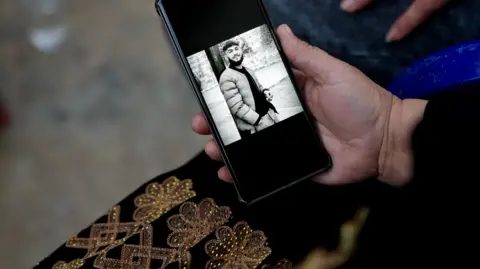
Walid Abdul-Basit Sheikh Mousa was obsessed with motorcycles and finally managed to buy one in January.
The 21-year-old has only had a few weeks to enjoy it. He was killed in February fighting IS in northeastern Syria.
Walid was so keen to take on the extremists that he ran away from home at the age of 15 to join the Kurdish-led Syrian Democratic Forces (SDF). They returned him because he was a minor, but after three years they accepted him.
Generations of his extended family gathered in the courtyard of their home in the town of Qamishli to tell us about his short life.
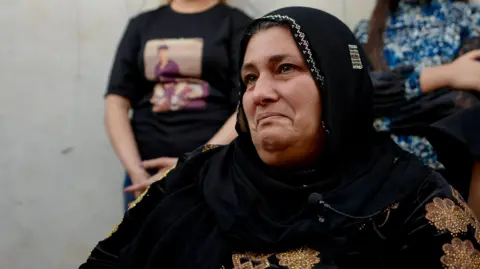
“I see him everywhere,” said his mother, Rojin Mohammed. “He left me with so many memories. He was very caring and affectionate.”
Walid was one of eight children and the youngest of the boys. He could always get around his mother.
“When he wanted something, he would come and kiss me,” she recalled. “And say ‘can you give me money so I can buy cigarettes?’
The young fighter was killed during days of fighting near a strategic dam – his body was discovered by his cousin who was searching the front lines. Through tears, his mother calls for revenge against IS.
 Göktai Koraltan/BBC
“They broke our hearts,” she says. “We buried so many of our little ones. May Daesh (IS) be completely destroyed,” she says. “I hope none of them are left.”
Instead, the Islamic State group has been recruiting and reorganizing — according to Kurdish officials — taking advantage of the security vacuum since the ouster of Syria’s longtime dictator Bashar al-Assad last December.
“There is a 10-fold increase in their attacks,” said Siyamand Ali, a spokesman for the People’s Protection Units (YPG), a Kurdish militia that has fought IS for more than a decade and is the backbone of the SDF.
 Göktai Koraltan/BBC
“They took advantage of the chaos and got a lot of weapons from warehouses and depots (of the old regime).”
He says the militants have expanded their areas of operation and methods of attack. They have gone from hit-and-run operations to attacking checkpoints and planting landmines.
The walls of his office are lined with pictures of YPG members killed by IS.
For the US, the YPG militia is a valuable ally in the fight against extremists. For Turkey, it is a terrorist group.
In the past year, 30 YPG fighters have been killed in operations against IS, according to Mr Ali, and 95 IS fighters have been captured.
The Kurdish authorities have their hands and prisons full of suspected IS fighters. Around 8,000 – from 48 countries including the UK, US, Russia and Australia – have been held for years in a network of prisons in the north-east of the country.
Whatever their guilt – or innocence – they were not tried or convicted.
The largest prison for IS suspects is al-Sina in the city of al-Hasakah – surrounded by high walls and watchtowers.
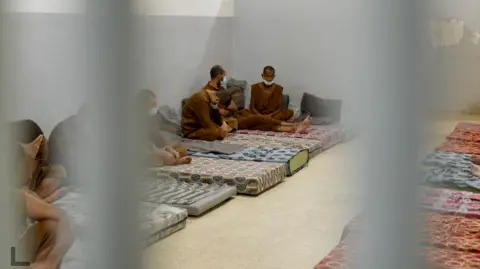
Through a small hatch in the cell door we see men who once terrorized about a third of Syria and Iraq.
The prisoners in brown uniforms – with shaved heads – sit silent and motionless on thin mattresses on either side of the cell. They look thin, weak and defeated, like the “caliphate” they proclaimed in 2014. Prison officials say these men were with IS until its last battle in the Syrian city of Baghouz in March 2019.
 Göktai Koraltan/BBC
Some detainees wear disposable masks to prevent the spread of infection. Tuberculosis is their companion in Al Sina, where they are detained indefinitely.
There is no television or radio, no Internet or telephone, and no word that Assad has been toppled by former Islamist fighter Ahmed al-Sharaa. At least that’s what prison authorities hope.
But IS is rebuilding behind bars, according to a prison commander, who could not be identified for security reasons. He says each wing of the prison has an emir or leader who issues fatwas – rulings on points of Islamic law.
“Leaders still have influence,” he said. “And give orders and lessons in Sharia.”
One of the detainees, Hamza Parvez from London, agreed to speak to us with the guards listening.
The former accountant trainee admits he became an IS fighter in early 2014 at the age of 21. It cost him his citizenship. When challenged about IS atrocities, including beheadings, he says many “unfortunate” things have happened.
“A lot of things have happened that I don’t agree with,” he said. “There were some things I agreed with. I wasn’t in charge. I was a normal soldier.”
He says his life is now in danger. “I’m on my deathbed … in a room full of tuberculosis,” he said. “I could die at any moment.”
After years in prison, Parvez is asking to be returned to the UK.
“I and the rest of the British citizens who are here in prison wish no harm,” he said. “We did what we did, yes. We came. We joined the Islamic State.” This is not something we can hide.’
I ask how people can assume he is no longer a threat.
“They’ll have to take my word for it,” he says with a laugh.
“That’s something I can’t convince people of. It’s a huge risk they’re going to have to take to bring us back. It’s true.”
Britain, like many countries, is in no rush to do this.
So the Kurds are left holding the fighters and about 34,000 of their family members.
Wives and children are arbitrarily detained in scattered, desolate tent camps that resemble open-air prisons. Human rights groups say this is collective punishment – a war crime.
Camp Roj is on the edge of the Syrian desert – battered by the wind and scorched by the sun.
It’s a place Londoner Mehak Aslam wants to escape. She comes to meet us in the manager’s office – a lightly veiled figure, with a mask on her face and limping. She says she was beaten by Kurdish forces years ago and wounded by a bullet fragment.
After agreeing to an interview, she spoke at length.
 Göktai Koraltan/BBC
Aslam says she came to Syria with her Bengali husband Shahan Chaudhary only “to bring aid” and claims they made a living by “baking cakes”. He is now in Al Sina prison and both have been stripped of their citizenship.
The mother of four denies joining IS but admits she brought her children to her territory, where her eldest daughter was killed by an explosion.
“I lost her in Baguz. It was an RPG (rocket-propelled grenade) or a small bomb. She broke her leg and was pierced by shrapnel from her back. She died in my arms,” she says in a low voice.
She told me that her children developed health problems in the camp, including her youngest, who is eight. But she admits she turned down an offer to bring them back to the UK. She says they didn’t want to go without her.
“Unfortunately, my children pretty much grew up only in the camp,” she said. “They don’t know the outside world. Two of my children were born in Syria, they’ve never seen Britain and to go to a family they don’t know again would be very difficult. No mother should have to make the choice to be separated from her children.”
But I told her she made other choices like coming to the caliphate where IS killed civilians, raped and enslaved Yazidi women and threw people off buildings.
“At the time, I didn’t know about the Yazidi stuff,” she said, “or that people were being thrown off buildings. We didn’t witness any of that. We knew it was very extreme.”
She said she was at risk in the camp because it was known she would like to return to Britain.
“I’ve already been branded as an apostate and it’s in my community. My children are being stoned at school.”
I asked if she would like to see the return of the IS caliphate.
“Sometimes things are skewed,” she said. “I don’t believe what we saw was a true representation, from an Islamic point of view.”
After an hour’s interview, she returned to her tent, with no sign of ever leaving the camp.
The head of the camp, Hekmiya Ibrahim, says there are nine British families in Roj – among them 12 children. And, she adds, 75 percent of those in the camp still adhere to IS ideology.
There are worse places than Roj.
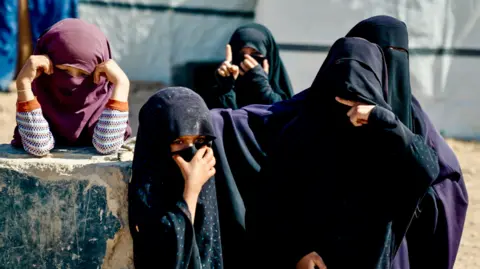
The atmosphere is far more tense in al-Hol, a more radicalized camp where about 6,000 foreigners are detained.
We were given an armed escort to enter their part of the camp.
As we entered – carefully – the sound of a crash echoed through the area. The guards said this was a signal that outsiders had arrived and warned us that we might be attacked.
 Göktai Koraltan/BBC
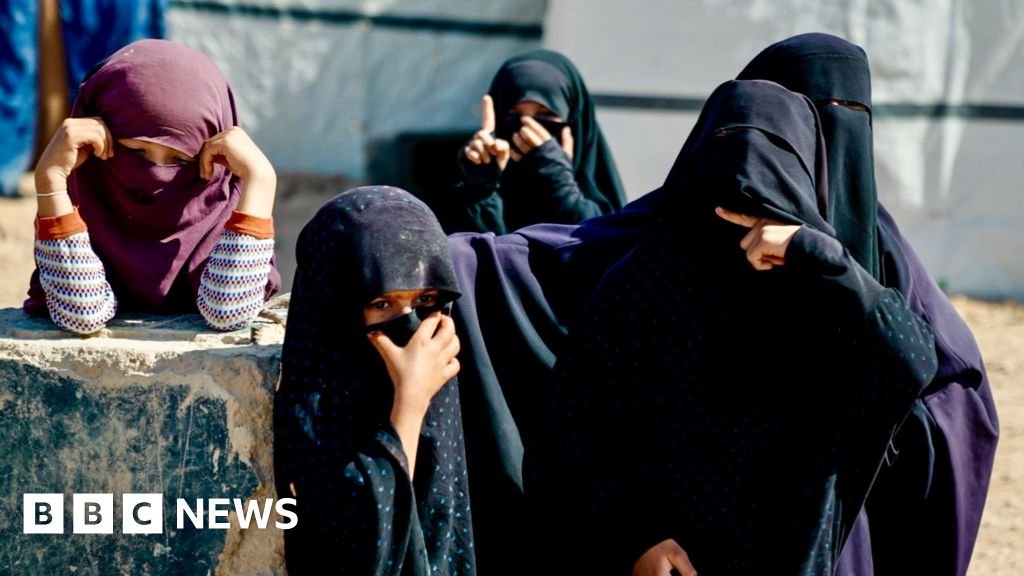
Veiled women soon gathered – dressed head to toe in black. One answered my questions by running a finger along her neck – as if she were cutting her throat.
Several young children raised an index finger, a gesture traditionally associated with Muslim prayer but hijacked by IS. We kept our visit short.
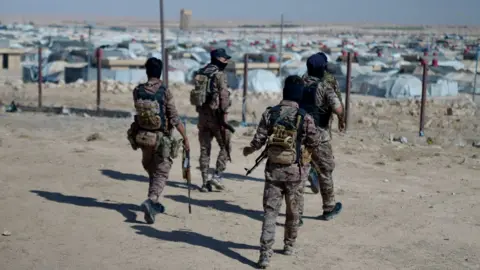
The SDF patrols outside the camp and the surrounding area.
We joined them – bumping along desert trails.
“Sleeper cells are everywhere,” said one of the commanders.
In recent months, they have been focused on trying to get the boys out of the camp, “trying to free the cubs of the caliphate,” he added. Most attempts are thwarted, but not all.
A new generation is being raised – in the barbed wire – inheriting the brutal legacy of IS.
“We are worried about the children,” Hekmiya Ibrahim said in Roj’s camp.
“We feel bad when we see them growing up in this swamp and accepting this ideology.
Because of their early indoctrination, she believes they will be even more hard-line than their fathers.
“They are the seeds for a new version of IS,” she said. “Even more powerful than the last one.”
Additional reporting by Wietske Burema, Goktay Koraltan and Fahad Fattah

Get our flagship newsletter with all the headlines you need to start your day. Register here.