Physical Address
304 North Cardinal St.
Dorchester Center, MA 02124
Physical Address
304 North Cardinal St.
Dorchester Center, MA 02124

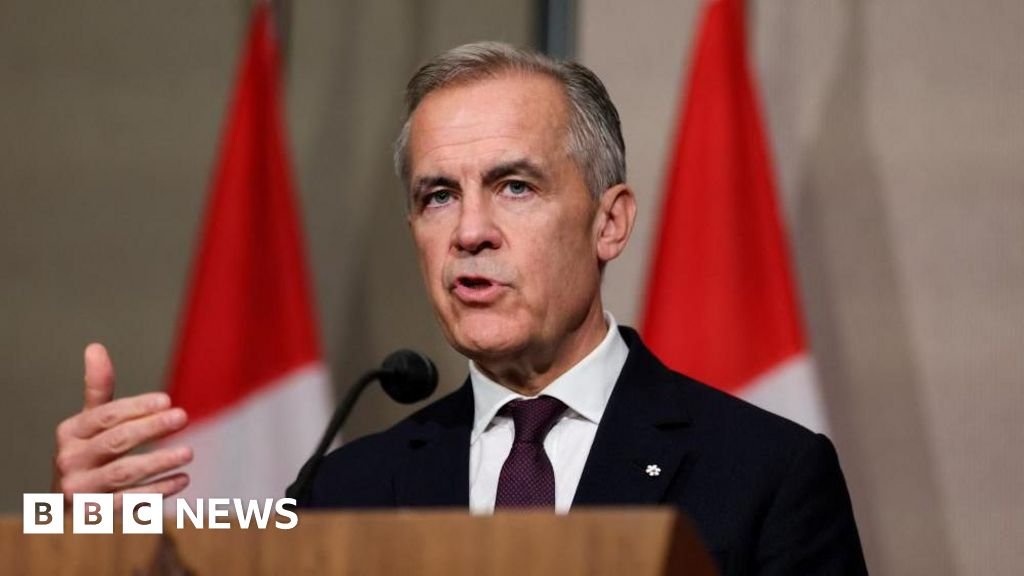
Canadian Prime Minister Mark Carney has accepted an invitation to visit China from President Xi Jinping, signaling a “turning point” in relations between the two countries.
The invitation came after the two leaders met for 40 minutes on the sidelines of this week’s Asia-Pacific Economic Cooperation (APEC) summit. It will be the first official summit between a Canadian prime minister and a Chinese president since 2017.
The two sides have been in strained relations since a diplomatic spat in 2018 and have been in a trade dispute since 2024.
But as trade tensions between Canada and the U.S. continue to rise, Carney said the country will focus on strengthening ties with other major economies.
He has signaled his desire to double Canada’s exports outside the US over the next decade in response to President Donald Trump, who has imposed heavy tariffs on Canadian goods and some of its critical sectors.
That includes closer trade ties with the “economic giants of Asia,” Carney said last week.
Speaking briefly to reporters after his meeting with Xi on Monday, Carney said he believes Canada and China have reached a “tipping point” in relations that will lead to positive developments for the Canadian economy.
“Distance is not the way to solve problems, it is not the way to serve our people,” the prime minister said.
In his own remarks, Xi said that “China is willing to work with Canada to bring China-Canada relations back to a healthy, stable and sustainable right track,” which benefits both countries.
The two leaders ordered their officials to “act swiftly to resolve outstanding trade issues and irritants,” according to information released by Carney’s office after the meeting.
The trade dispute has escalated since Canada imposed 100% tariffs on Chinese electric vehicles (EVs) in October 2024, mirroring similar actions by the US. Later that month, Canada imposed 25% tariffs on Chinese steel and aluminum.
China retaliated in March by imposing tariffs on several Canadian agricultural products, including a 76% tax on imports of canola seed and a 100% tax on canola oil, flour and peas.
These measures hurt farmers in western Canada, as China is the country’s largest importer of canola seed.
Some western provincial premiers, including Manitoba’s Wab Kinew and Saskatchewan’s Scott Moe, have since called on the federal government to remove tariffs on Chinese electric cars. Kinew said earlier this month that Canada has found itself in a “two-front trade war” with its two biggest trading partners, the US and China.
Separately, the US imposed a 35% tariff on all Canadian goods not covered by an existing free trade agreement, as well as a 50% tax on steel and aluminum and a 25% tax on cars.
US-Canada relations hit a new low last week after Trump suspended all trade talks over an anti-tariff ad released by Ontario Premier Doug Ford that included former US President Ronald Reagan’s free trade address.
On Friday, Trump said the two countries would not resume trade talks.
Trump has also threatened to raise tariffs on Canada by another 10%, although it is unclear if and when that will take effect.
Before the tariffs, Canadian-Chinese relations were already reeling from a diplomatic row that led to Beijing detaining two Canadian citizens, Michael Spavor and Michael Kovring.
The two were accused by China of espionage and detained in 2018. Their arrest came days after Canada detained Meng Wanzhou, the Chinese technology executive and chief financial officer of Huawei, at the request of the US.
All three were subsequently released in 2021 after the US Department of Justice rejected a request to extradite Ms Wanzhou on fraud charges.
China was also one of the countries called out for possible interference in the 2019 and 2021 Canadian elections, prompting a Canadian public inquiry into foreign interference. This investigation concluded that attempts by foreign countries to interfere in recent elections were “disturbing” but had “minimal impact”.
China has rejected any accusations of interference.
Carney’s APEC meeting with Xi in South Korea comes a day after the Chinese president met with Donald Trump – the first between the two in six years.
At that meeting on Thursday, Xi and Trump agreed to roll back their countries’ trade war. No formal agreement has been signed, but the two have signaled they are closer to a deal that would lower tariffs.


