Physical Address
304 North Cardinal St.
Dorchester Center, MA 02124
Physical Address
304 North Cardinal St.
Dorchester Center, MA 02124

 Getty Images
When Anna planned her first visit to Xinjiang in 2015, her friends were puzzled.
“They couldn’t understand why I would visit what was then considered one of the most dangerous areas in China.”
One of her friends pulled out of the trip and started “ghosting” her on WeChat, said the 35-year-old Chinese woman, who did not want to give her real name.
“She said that her parents have forbidden her to go near Xinjiang and she doesn’t want to deal with it anymore.”
Anna went anyway and came back this June. But that has changed, she says.
“Xinjiang was as beautiful as I remember it, but now there are too many tourists, especially at the main attractions.”
For years, Xinjiang had bristled under Beijing’s rule, sometimes erupting in violence that put off many local Chinese tourists. It then became infamous for some of the worst accusations of Chinese authoritarianism, from detaining more than a million Uighur Muslims in the so-called “re-education camps”, to allegations of crimes against humanityfrom the UN.
China denies the allegations, but the region has been largely cut off from international media and observers, while exiled Uyghurs continue to tell stories of terrified or missing relatives.
Yet in recent years, Xinjiang has become a tourist destination – in China and increasingly outside the country. Beijing has pumped in billions of dollars to develop infrastructure, help create television dramas set in its unusual landscapes, and occasionally welcomes foreign media on carefully orchestrated tours.
It has repackaged the controversial region as a tourist haven, touting not just its beauty but the many local “ethnic” experiences that rights groups say it is trying to erase.
 Anna
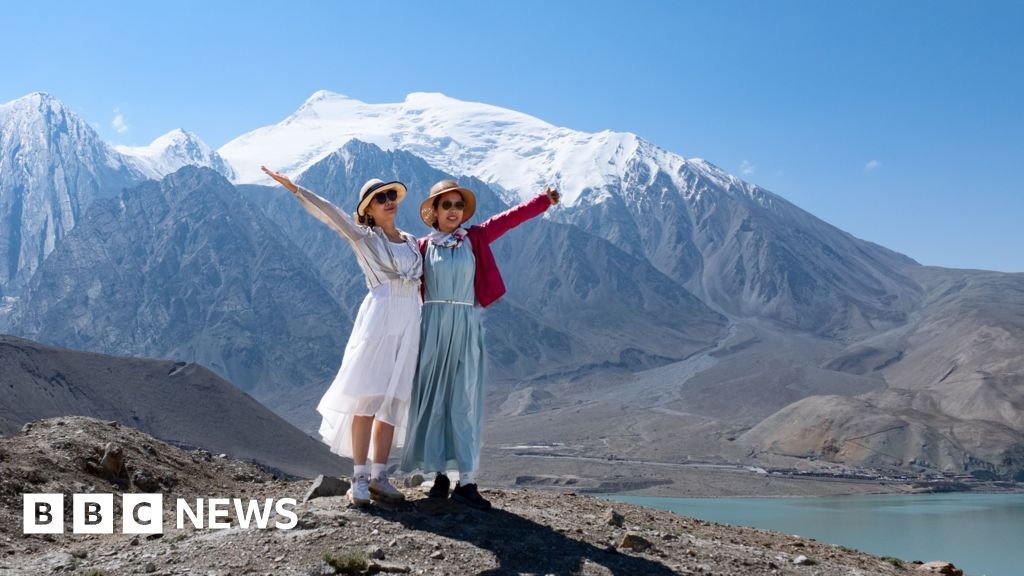
AnnaLocated in northwest China, Xinjiang borders eight countries. Located along the Silk Road, which fueled trade between East and West for centuries, some of its cities are steeped in history. It is also home to remote, rugged mountains, majestic canyons, lush grasslands and pristine lakes.
“The views exceeded my expectations by miles,” said Singaporean Sun Shengyao, who visited in May 2024 and described it as “New Zealand, Switzerland and Mongolia all rolled into one.”
Unlike most of China, where the majority are Han, Xinjiang has a predominantly Turkic-speaking Muslim population, with the Uyghurs being the largest ethnic group. Tensions escalated in the 1990s and 2000s as Uyghur accusations of marginalization by Han Chinese sparked separatist sentiment and deadly attacks, intensifying Beijing’s crackdown.
But it was under Xi Jinping that the Chinese Communist Party began to tighten control like never before, prompting allegations of forced assimilation of Uyghurs into Chinese Han culture. On a visit in September, he hailed the region’s “ground-breaking” development and called for the “sinization of religion” – a transformation of beliefs to reflect Chinese culture and society.
Meanwhile, investment is pouring into the region. About 200 international hotels, including big names like Hilton and Marriott, are either already operating or planning to open in Xinjiang.
In 2024, the region welcomed about 300 million visitors, more than double the number in 2018, according to Chinese officials. Tourism revenue from Xinjiang grew by around 40% during that period, reaching 360 billion yuan ($51 billion; £39 billion). In the first half of this year, about 130 million tourists visited the region, contributing about 143 billion yuan in revenue.
While foreign tourism is growing, the vast majority are domestic visitors.
Beijing now has an ambitious goal: more than 400 million visitors a year and tourism revenue of 1 trillion yuan by 2030.
 Getty Images
Some people are still afraid to go. Mr. Sun says it took him a while to gather friends for the May 2024 trip because many of them considered Xinjiang dangerous. The 23-year-old himself had a bout of nervousness, but as the trip went on, they disappeared.
They started on the busy streets of the regional capital Urumqi. They then spent eight days on the road with a Chinese driver, traveling through mountains and lush steppes that left Mr Sun in awe.
It is common for drivers and tour guides in Xinjiang to be Han Chinese, who now make up about 40% of the region’s population. Mr. Sun’s group did not interact widely with local Uyghurs, but the few they were able to strike up conversations with were “very welcoming,” he says.
Since his return, Mr. Sun has become somewhat of a defender of Xinjiang, which he says has been “misunderstood” as dangerous and tense. “If I can inspire just one person to learn more about the province, I’ve helped reduce the stigma a little bit.”
To him, the stunning sights he enjoyed as a tourist seem a far cry from the troubling allegations that have put Xinjiang in the world’s headlines. All he saw was evidence that Xinjiang remains heavily monitored, with police checkpoints and security cameras a common sight, and foreigners required to stay in designated hotels.
But Mr Sun was unfazed by this: “There is an increased police presence, but that doesn’t mean it’s a big problem.”
Not every tourist is convinced that what they see is the “real” Xinjiang.
Singaporean Tenmoli Silvadori, who visited with friends in May for 10 days, said: “I was very curious about Uighur culture and wanted to see how different things are there. But we were quite disappointed.”
She and her friends wore hijabs and, she says, Uyghur food vendors had approached them, saying they were “envious that we can freely wear our hijabs … but we haven’t been able to have very deep conversations.” They were also not allowed to visit most local mosques, she adds.
 Getty Images
Still, the appeal to foreign visitors is strong. China itself is a hugely popular destination, and Xinjiang emerges as an ‘unspoiled’, less commercialized option.
A growing number of foreigners are “approaching Xinjiang with open minds and a sincere desire to see and appreciate the truth for themselves,” China’s state-run Global Times newspaper wrote in May.
The party has also been quick to promote content about Xinjiang from foreign influencers that aligns with the state’s narrative. Among them is German vlogger Ken Abroad, who said in one of his videos that he saw “more mosques (in Xinjiang) than in the US or any country in Europe.”
But others have a different opinion. Writer Josh Summers, who lived in Xinjiang in 2010, told the BBC that Kashgar’s old town had been “completely demolished, reimagined and rebuilt in a way that in no way reflects Uyghur culture”.
According to a 2024 Human Rights Watch report, hundreds of villages in Xinjiang had their own names – which are related to Uyghur religion, history or culture – replaced between 2009 and 2023. The group also accused authorities of closing, demolishing and rearranging mosques in Xinjiang and throughout China to restrict the practice of Islam.
Serious rights violations have also been documented by other international organizations, including the United Nations. BBC reporting in 2021 and 2022 found evidence to support the existence of detention camps and allegations of sexual abuse and forced sterilization.
However, Beijing denies all this. Domestically, the party is revamping the image of what was once considered a troubled province to attract more domestic tourists. And it seems to be working.
 Anna
AnnaWhen Anna went the second time, it was with her mother, who was eager to visit after watching a drama series set in the mountainous Altai Prefecture in the north. The To the Wonder series was funded by the government and promoted in the state media.
Altay has many fans on the Chinese Internet. “Who could have known that I would wander into God’s secret garden in Altai? At Lake Ka Nasi, I finally understood what it means to be in paradise. It is a place where the romance of mountains, rivers, lakes and seas are woven into one frame,” reads one comment on RedNote.
Another says: “At dawn, I watch from the guest house as cattle graze the fields. Golden birch forests glow in the sunlight and even the air seems wrapped in sweetness – such undisturbed beauty is the Altai I have always longed for.”
Travel agencies describe the region as “exotic” and “mysterious”. It offers “a magical fusion of nature and culture that you won’t experience anywhere else in China,” says one such agency, The Wandering Lens. Prices for these tours vary. A 10-day trip can cost you between $1,500 and $2,500 (£1,100-£1,900), excluding flights.
A typical northern itinerary would include Kanas National Park with trips to alpine lakes and the popular Five Color Beach and a visit to a Uyghur village where you can ride carriages and spend time with a Uyghur family.
Things get more adventurous in the south, where trips often include desert drives, various lake excursions and a visit to Kashgar, a 2,000-year-old city on the Silk Road.
Visitors share their itineraries online, complete with color-coded route maps and photos of Uyghur delicacies such as spicy stew, “big plate chicken,” grilled lamb skewers, and horse milk wine. Some even mention “hourly shows that recreate the splendor of the Silk Road”.
If you search for Xinjiang on social media platforms RedNote and Weibo, as you’d expect, you get posts raving about its beauty and iconic architecture. No mention is made of the charges that beset this idyllic appeal.
At this time of year, Chinese social media is filled with photos of Xinjiang’s poplar forests bathed in autumn’s amber glow.
The Communist Party is “selling its own version of Uyghur culture by presenting the Uyghur people as tourist attractions,” says Irade Kashgari, a Uyghur-American who left the region in 1998.
“They’re telling the world that we’re nothing more than dancing, colorful people who look good on social media.”
Watching her hometown grow in popularity from across the Pacific, Ms Kashgari, the Uighur activist, is urging tourists to “recognize the serious problems” in Xinjiang.
“It’s not my job to tell people not to visit, but they should realize that what they’re experiencing there is a labeled version of (Xinjiang),” she says.
“Meanwhile, people like me will never be able to go back because of our activism. It’s too dangerous… and yet, why can’t I? This is my homeland.”