Physical Address
304 North Cardinal St.
Dorchester Center, MA 02124
Physical Address
304 North Cardinal St.
Dorchester Center, MA 02124

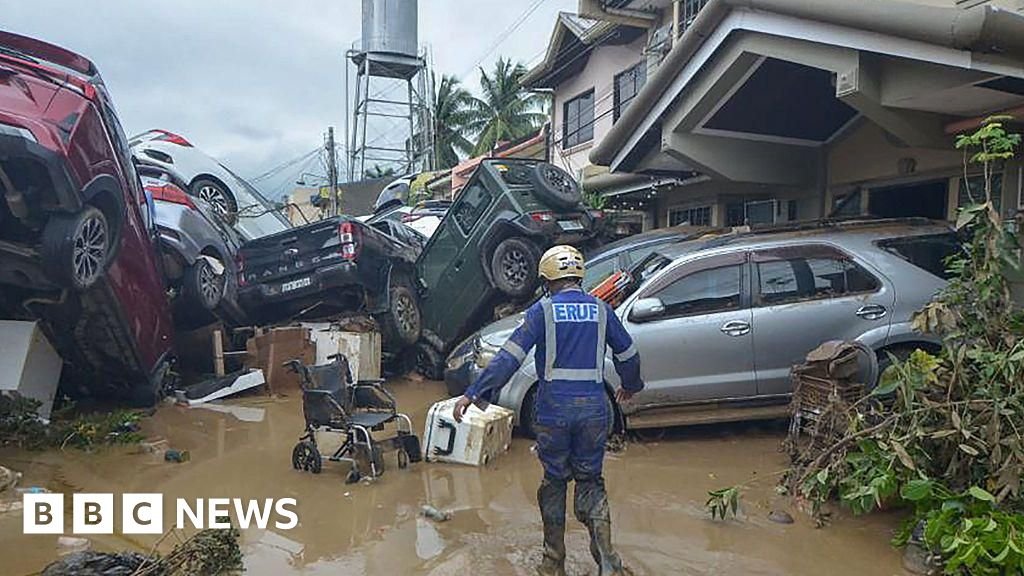
At least 26 people were killed and hundreds of thousands forced from their homes as one of the strongest typhoons this year slammed into the central Philippines, officials said.
Typhoon Kalmaegi flooded large areas, including entire towns on the most populous central island of Cebu, where the number of victims was highest. Reports indicate that casualties will increase.
Videos show people hiding on rooftops as cars and containers are swept across the streets.
A military helicopter sent to aid humanitarian operations has crashed in the northern part of the island of Mindanao, killing six crew members on board, the Philippine Air Force (PAF) said.
He went down near Agusan del Sur on the island of Mindanao and was one of four sent to help.
“Communication with the helicopter was lost, which immediately led to the initiation of a search and rescue operation,” the PAF said. A spokesman later said six bodies, believed to be those of the pilot and crew, had been recovered.
The typhoon, locally named Tino, has weakened since making landfall early Tuesday but continued to pack winds of more than 80 mph (130 km/h).
It is expected to move through the Visayas region and exit the South China Sea by Wednesday.
“The situation in Cebu is truly unprecedented,” provincial governor Pamela Barricuatro said in a Facebook post.
“We expected the winds to be the dangerous part, but … the water is what really puts our people at risk,” she said. “The flooding is just devastating.”
Most of the deaths were due to drowning, reports said. The storm sends torrents of muddy water down hillsides and into towns.
Damage to Cebu’s residential areas was extensive, with many small buildings swept away and a thick carpet of mud left by the receding floodwaters. Rescue teams boarded boats to free people who were trapped in their houses.
Don del Rosario, 28, was among those in Cebu City who sought refuge upstairs as the storm raged.
“I’ve been here for 28 years and this is the worst we’ve ever experienced,” he told AFP.
In total, almost 400,000 people were moved out of the typhoon’s path, Rafaelito Alejandro, deputy administrator at the Office of Civil Defense, told a news conference.
The Philippines is hit by an average of 20 storms and typhoons each year.
The latest comes barely a month after typhoons killed more than a dozen people and damaged infrastructure and crops.
Super typhoon Ragasa, known locally as Nando, struck in late September, followed quickly by Typhoon Bualoi, known locally as Oppong.
In the months before, an extremely wet monsoon season had caused widespread flooding, caused anger and protests over unfinished and substandard flood control systems that were accused of corruption.
On September 30 dozens were killed and wounded after a powerful 6.9 magnitude earthquake struck the central Philippines, with Cebu bearing the brunt of the damage.
Typhoon Kalmaegi is forecast to move towards Vietnam, where there is already record rainfall.
With additional reporting by Jonathan Head, Southeast Asia correspondent


