Physical Address
304 North Cardinal St.
Dorchester Center, MA 02124
Physical Address
304 North Cardinal St.
Dorchester Center, MA 02124

 Reuters
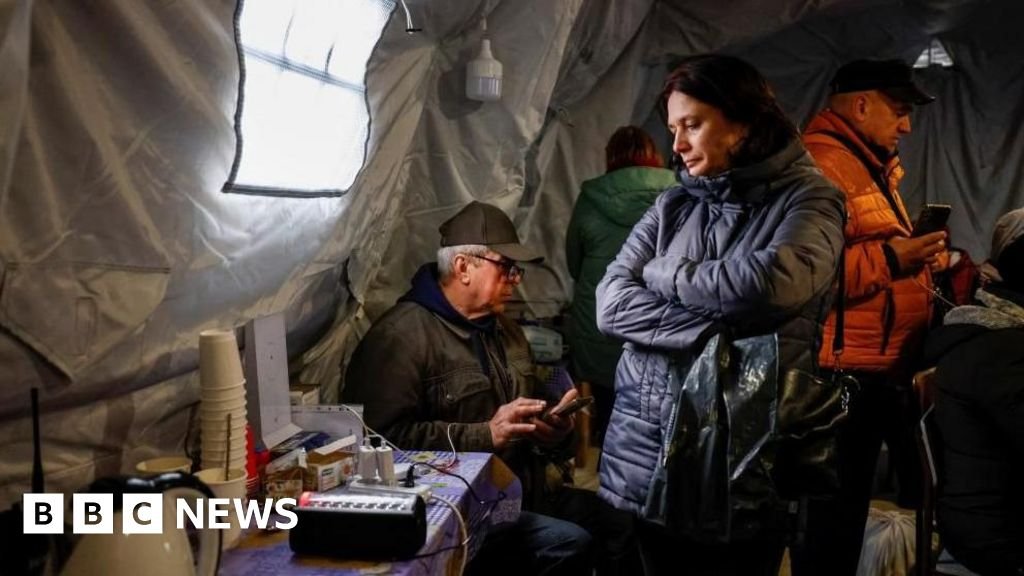
The Ukrainian city of Chernihiv is in total blackout after what authorities describe as a “large-scale” attack by Russian missiles and drones, with hundreds of thousands of people affected.
In the wider Chernihiv region, four people were reported killed, while residential areas were hit in the city of Novgorod-Siverskyi.
Ten others were injured, including a 10-year-old girl.
The country’s northernmost region is the latest to be hit in an escalating series of attacks on civilian infrastructure as Russia targets energy supplies, the rail network, homes and businesses in its full-scale invasion of Ukraine.
“I personally heard the drones flying overhead,” said 55-year-old Alexander Babic.
The resident of the city of Chernihiv spoke candidly about a night filled with the low whine of Iranian-made Shahed drones, a sound now heard increasingly far from the war’s front lines.
“Unfortunately, our region is very close to our scheming neighbor,” he said, adding an expletive for good measure.
Chernihiv Oblast borders both Russia and Belarus, giving air defenses here less time to react to any incoming attacks.
In an attack involving more than 100 Shahed drones – each carrying a 50kg warhead – and six ballistic missiles, direct hits on power generation facilities in Chernihiv left the entire city without power, as well as large parts of the surrounding area.
Andriy Podorvan, deputy head of the Chernihiv Regional Military Administration, told the BBC that this was part of a pattern across much of the country, with things getting much worse in recent months.
“For about half a year, we have been experiencing targeted strikes on the energy infrastructure in our region,” he said.
“The number of attacks has increased significantly in the last two months.
When I asked him if he thought any of the targets had military value — Moscow’s usual justification for these kinds of attacks — he pointed out that Russia had even attacked gas stations.
“I only see hits on civilian infrastructure,” he said.
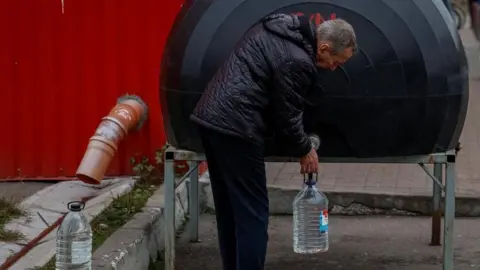
The attack on the power grid also means a loss of power to the water pumping stations, severely affecting supplies. Residents have been told to stock up on bottled water or have to rely on emergency supplies.
 Reuters
As the attacks continued into the morning, electrical engineers had to delay their initial response, but were later able to begin working to restore power.
The wider concern is that if the intensity of Russian bombing continues, it risks quickly depleting the country’s energy resilience, dealing a heavy blow to the economy and – with the coming harsh winter – a psychological blow to society as well.
Until now, the country’s generating companies – working together in the spirit of wartime cooperation – have been able to restore power relatively quickly, but supplies of spare equipment are not unlimited.
A single transformer can take more than a year to produce, with additional time for shipping and installation.
The country should seek all the help it can get.
Ukrainian President Volodymyr Zelensky’s recent meeting with US President Donald Trump in Washington could be seen as a strategic disappointment as it ended without securing the delivery of long-awaited Tomahawk long-range missiles.
But his meetings with the heads of leading American energy companies, where they discussed ways to help Ukraine strengthen and modernize its energy sector, were successful.
Some estimates put the total cost of damage to Ukraine’s energy infrastructure so far at more than $16 billion (€13.7 billion; £11.9 billion).
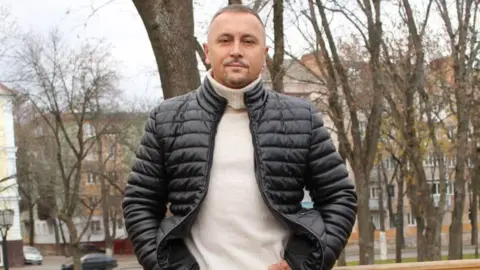
In Chernigov, regional official Andriy Podorvan told the BBC that he believed Russia was unable to make significant progress on the front line and therefore now saw the civilian population as a weak point.
But he thinks this is misjudged.
People understand who is the enemy and who is to blame in this situation,” he said. “This will lead to even greater unity of the population.
Mr. Babic agrees.
“Although, yes, there are inconveniences, the majority of the population is ready for it,” he insisted.
Many went back to business as usual, he said, with backup generators for important facilities like hospitals and government buildings, and neighbors helping each other out.
“The hero city of Chernigov did not surrender and will not surrender. Morale is high.”