Physical Address
304 North Cardinal St.
Dorchester Center, MA 02124
Physical Address
304 North Cardinal St.
Dorchester Center, MA 02124

 @realDonaldTrump/Truth Social
Ecuador frees survivor of US strike on submarine allegedly carrying drugs to Caribbean.
The US military captured the Ecuadorian national along with the Colombian national after raiding the submarine the two were on. US President Donald Trump said they would be returned to their countries of origin “for detention and prosecution”.
But Ecuador’s attorney general’s office said in a statement that the surviving Ecuadorian “cannot be detained” because “there is no report of a crime that has been brought to the attention of this institution.”
The US has launched a series of strikes on what it describes as drug-smuggling vessels in the region.
Ecuadorian authorities earlier identified one of the survivors of Thursday’s strike as Andres Fernando Tufinho.
He and the Colombian, identified as 34-year-old Jason Obando Perez, are the first two people to survive one of the US strikes in the Caribbean as part of a massive anti-narcotics operation.
Two other men aboard the semi-sub were killed in the attack, Trump said.
The US military said at least 32 people had been killed in at least seven separate strikes since early September.
Experts question the legality of the attacks, saying they violate international law.
But the Trump administration insists it is targeting “narco-terrorists.”
Asked about the two survivors by reporters at the White House on Friday, Trump said they were aboard a “drug-carrying submarine built specifically to transport massive amounts of drugs.”
“This was not an innocent group of people,” he added. “I don’t know too many people who have submarines, and this was an attack on a drug-laden submarine.
The US president claimed in a post on his Truth Social account that the ship was carrying “mostly fentanyl and other illegal drugs”.
Drug trafficking experts have indicated that fentanyl enters the US primarily from Mexico, rather than from countries bordering the southern Caribbean where the US deployment takes place.
About 10,000 US troops, as well as dozens of military aircraft and ships, have been deployed to the Caribbean as part of the operation.
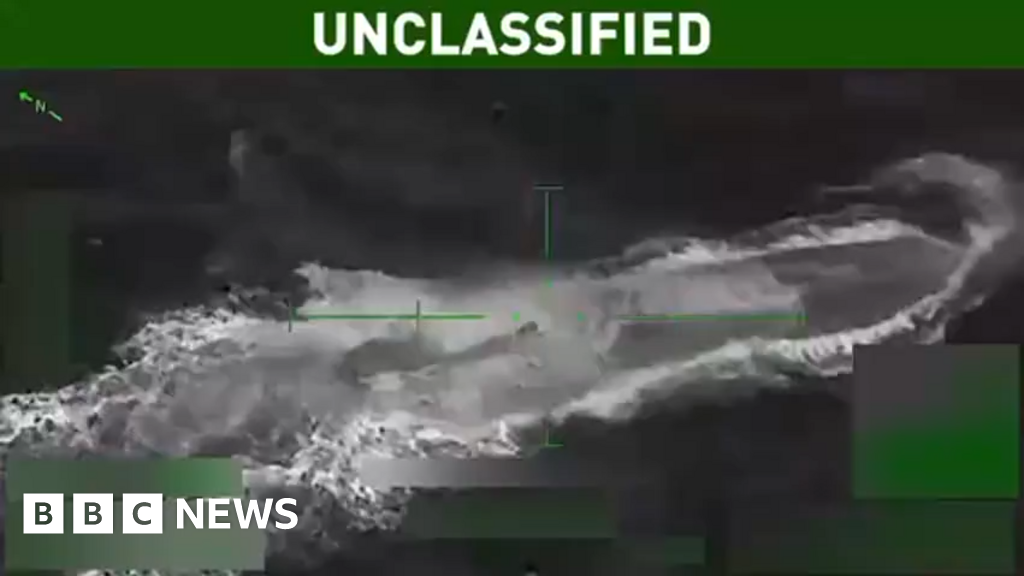
Trump also released a 30-second video showing the semi-submersible in rough waters before it was hit by at least one projectile.
The two men were rescued by a US military helicopter and then taken to a US warship in the Caribbean before being repatriated.
The surviving Ecuadorian was in good health, according to an unnamed official quoted by the Associated Press.
The AP also reported that it had seen a document from the Ecuadorian government that outlined “there is no evidence or indication that could lead prosecutors or judicial authorities to be certain” that Tufiño violated existing laws on Ecuadorian territory.
The Colombian survivor arrived in his homeland “with a traumatic brain injury, sedated, medicated and breathing with the help of a ventilator,” according to Colombia’s interior minister.
He was taken to a hospital in the capital Bogota for treatment, local media reported.
Minister Armando Benedetti said the man was on “a vessel full of cocaine, and that in our country is a crime”.
The deployment of U.S. forces in the Caribbean is mainly aimed at ships leaving Venezuela, according to U.S. officials.
Trump has accused his Venezuelan counterpart Nicolas Maduro of running a drug-trafficking group called the Cartel of the Suns.
Maduro has denied the charges and said the operation was aimed at removing him from power.
The Venezuelan leader, whose re-election last year was not recognized by the US and many other nations, addressed Trump directly, saying he wanted “peace”.
But the US government is stepping up its pressure on Maduro, with Trump confirming last week that he had given the CIA the green light to carry out covert operations in Venezuela.
US officials said previous strikes on “drug boats” had targeted the Tren de Aragua gang, which is based in Venezuela.
But as more boats are hit, questions about the identities of those on board grow.
Colombian President Gustavo Petro accused the US of attacking a ship in “Colombian territorial waters” in September, saying the strike amounted to “murder”.
In response, Trump called Petro an “illegal drug leader” who “strongly promotes the mass production of drugs, in fields large and small, throughout Colombia.”
He also said the US would no longer offer aid to Colombia and threatened to impose tariffs on Colombian goods.
Media in Trinidad and Tobago are also pressuring the government of the twin island nation to investigate reports that two of its citizens were killed in one of the strikes.
On Tuesday, however, the government of Trinidad and Tobago expressed its “strong support for the continued military intervention of the United States of America in the region.”
“These operations aimed at combating drug and human trafficking and other forms of transnational crime ultimately aim to enable the region to be a true ‘Zone of Peace’ where all citizens can truly live and work in a safe environment,” the foreign ministry said in a statement.
Additional reporting by BBC News Mundo