Physical Address
304 North Cardinal St.
Dorchester Center, MA 02124
Physical Address
304 North Cardinal St.
Dorchester Center, MA 02124

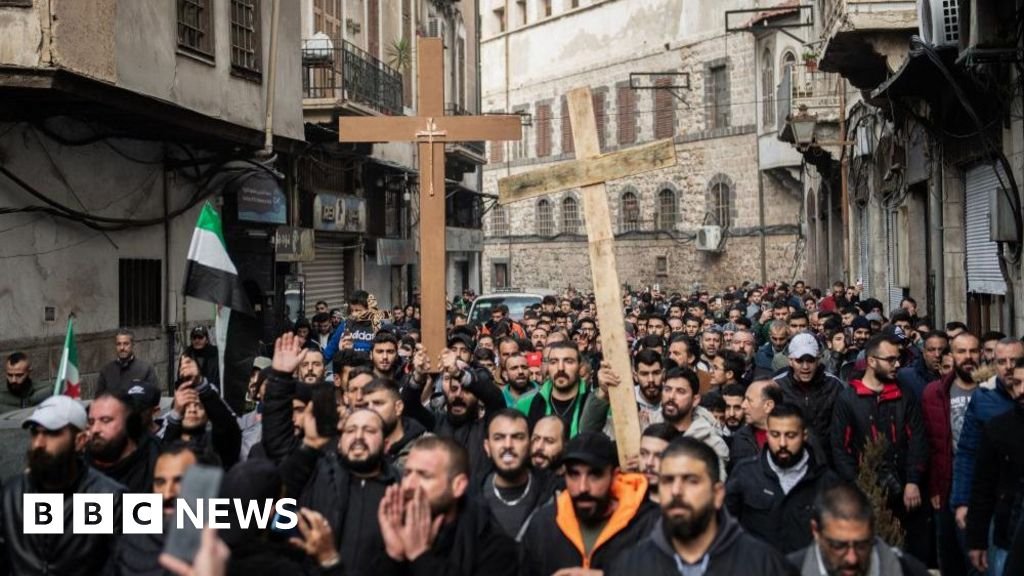
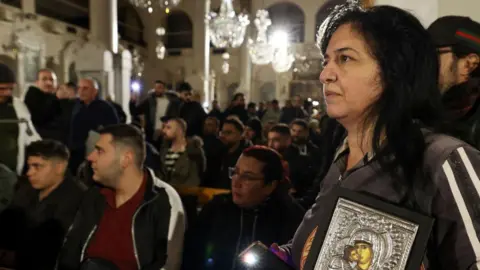
Protests have erupted in Syria over the burning of Christmas trees, prompting calls for the new Islamist government to take steps to protect minorities.
A video posted on social media shows a burning tree in the main square of Suqaylabiya, a Christian-majority city in central Syria.
Hayat Tahrir al-Sham (HTS), the main Islamist faction that led the uprising that ousted President Bashar al-Assad, said foreign fighters had been detained over the incident.
HTS representatives pledged to protect the rights and freedoms of religious and ethnic minorities in Syria.
Footage has emerged on social media showing masked men dousing a Christmas tree with an unidentified liquid the night before Christians in Syria prepare to celebrate Christmas Eve. It is not clear whether they were trying to put out the fire or help it spread.
Videos of the aftermath showed a religious figure from the ruling HTS rebel group assuring crowds gathered in Sukailabiya that the tree would be repaired before morning.
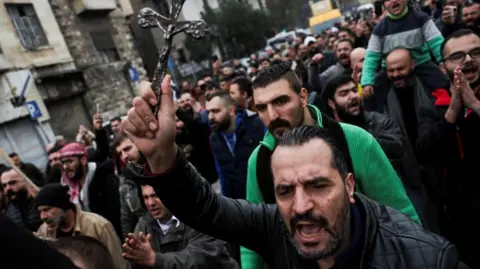
The man then held up a cross in solidarity, something Islamist conservatives would not normally do.
 Reuters
On Tuesday, more protesters took to the streets over the arson, including in parts of the capital, Damascus.
Some in the Qassa neighborhood of Damascus chanted against foreign fighters in Syria.
“Syria is free, non-Syrians must leave,” they said, referring to the foreign fighters HTS said were behind the attack.
In the Bab Touma neighborhood of Damascus, protesters carried a cross and Syrian flags, chanting “we will sacrifice our souls for our cross.”
“If we are not allowed to live our Christian faith in our country as before, then we no longer belong here,” a demonstrator named Georges told the AFP news agency.
Syria is home to many ethnic and religious groups, including Kurds, Armenians, Assyrians, Christians, Druze, Alawite Shiites, and Arab Sunnis, the latter of whom make up the majority of the Muslim population.
Just over two weeks ago, the presidency of Bashar al-Assad fell to rebel forces, ending more than 50 years of rule by the Assad family.
Since then, many displaced Syrians have started to return to their homes – on Tuesday, Turkey said more than 25,000 Syrians had returned to the country.
However, it remains to be seen how the HTS group will govern Syria.
HTS began as a jihadist group – advocating violence to achieve its goal of creating a state governed by Islamic (Sharia) law – but in recent years has adopted a more pragmatic, less uncompromising approach.
As the fighters marched on Damascus earlier this month, its leaders spoke of building a Syria for all Syrians.
On Tuesday, the new authorities announced that leader Ahmed al-Sharaa had reached an agreement with “revolutionary factions… to dissolve all factions and unite them under the auspices of the Ministry of Defense,” according to the Sana news agency.
Prime Minister Mohammed al-Bashir said the ministry would be restructured to include rebel fighters.
Although the statement mentioned “all factions”, it was unclear exactly which groups were included in the merger.
There are multiple armed groups in Syria, including some that oppose HTS and others with at best an ambivalent relationship with it.
 Getty Images
HTS remains designated as a terrorist organization by the UN, US, EU and UK, although there are signs that a diplomatic shift may be underway.
on friday, The US dropped a $10m (£7.9m) reward. led by HTS leader Ahmed al-Sharaa, following meetings between senior diplomats and representatives of the group.
The US continues its military presence in Syria. On Friday, it said it had carried out an airstrike in the northern city of Deir Ezzor, killing two members of the Islamic State (IS) jihadist group.
The presence of foreign fighters, Islamist extremists or even regime supporters who have an interest in creating insecurity and attacking minorities to destabilize the country are the major challenges that the new Islamic leadership will face.



