Physical Address
304 North Cardinal St.
Dorchester Center, MA 02124
Physical Address
304 North Cardinal St.
Dorchester Center, MA 02124

BBC News, Kaduna
 Ifiokabasi Ettang / BBC
For more than 50 years, one family has dedicated itself to tending the largest cemetery in Nigeria’s northern city of Kaduna – much to the gratitude of other residents who don’t like the job of dealing with the dead.
Until a few weeks ago, they did so without official pay – digging graves, washing corpses and tending the vast cemetery, receiving only small donations from mourners for their labor.
The vast Tudun Wada cemetery was set aside for the city’s Muslim residents by the authorities a century ago.
The Abdullahi family got involved in the 1970s when two brothers – Ibrahim and Adamu – started working there.
The two siblings now lie underground in the cemetery, and their sons have become chief guardians of the cemetery.
“Their teachings to us, their children, was that God loves service and will reward us for it even if we don’t get any worldly gains,” Ibrahim’s eldest son Abdullahi Magaji told the BBC when asked why they chose to continue as unpaid undertakers.
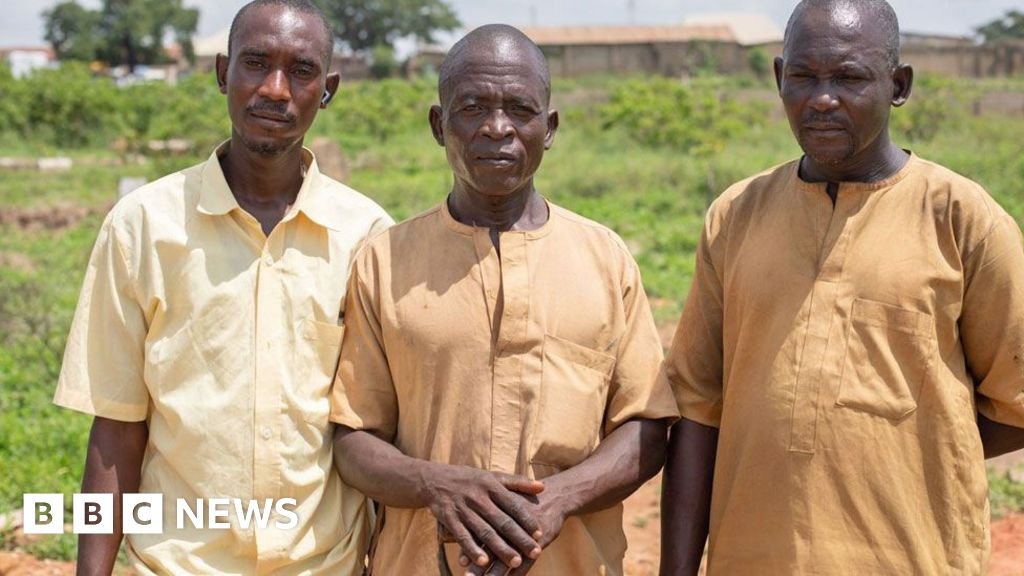
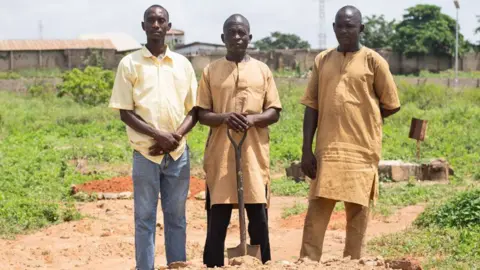
The 58-year-old is now in charge of Tudun Wada – shepherding operations and the 18 members of staff or until recently – volunteers.
He and his two younger cousins - Abdullahi, 50, and Aliyu, 40, (sons of Adamu Abdullahi) – are the three full-time workers, all turning in by 07:00 for a 12-hour shift, seven days a week .
They must always be on call because according to Muslim rituals, a funeral must be arranged within a few hours of someone’s death.
 Ifiokabasi Ettang / BBC
Magaji tends to get his mobile phone call directly from a relative or from an imam – all the religious clerics in town have his number.
“A lot of people have our numbers, and as soon as someone dies, we get a call and we go straight to work,” he says.
One of the trio goes to take care of the corpse, which may include washing it and wrapping it in a shroud.
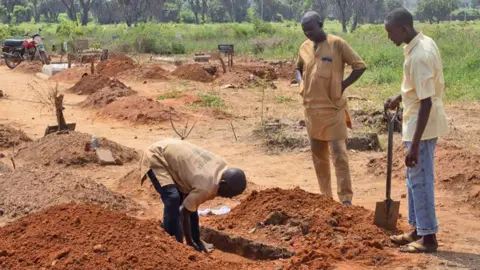
The body is measured and these details are sent to the others so that a grave can be dug.
This can take about an hour – with two people taking turns to dig down 6 feet (1.8 m) into the ground – sometimes more when it’s in a rocky area of the cemetery.
They can dig about a dozen graves in a day – hard work in the Kaduna heat.
“We dug up eight graves today alone and it’s not even noon, some days are like that,” said Abdullahi, who started working at the cemetery when he was 20 years old.
The cousins have experienced many stressful times – especially during times of religious violence, when tensions flared between the city’s Christians and Muslims. The two communities tend to live on opposite sides of the Kaduna River.
 Ifiokabasi Ettang / BBC
“We had several religious clashes in Kaduna but the one that stuck with me the most was in the early 1990s. Many people were killed,” says Magaji.
“We went around picking up the bodies and taking them off the streets.”
The Muslims were taken to Tudun Wada in the northern part of the city and the Christians to the cemeteries in the southern suburbs.
“It was such a worrying time personally and I wasn’t on the job for long at the time, but it helped strengthen my resolve to carry on,” he says.
Usually, while the team is digging a grave, at the local mosque the imam announces during one of the five daily prayers that there will be a funeral.
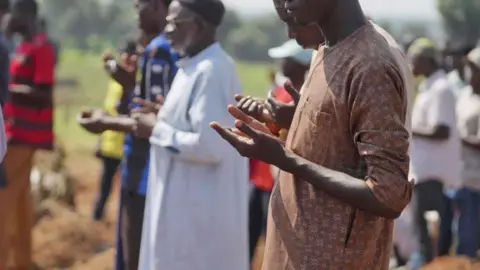
Many of the pilgrims then go to where the body has been prepared for prayers – it is then transported to the cemetery for burial, often crowded with mourners.
Once at the grave, the wrapped body is lowered – it is covered with a layer of sticks and broken pottery as a sign of respect. The grave is then filled to form a slightly raised bed.
After the rites are over and before the mourners leave, cemetery officials appeal for donations.
This is usually done by 72-year-old Inuwa Mohammed, the cemetery’s oldest worker, who explains the importance of the Abdullahi family to the community.
He worked with the cousins’ fathers: “They were amazing people who loved what they did and instilled this altruistic behavior in their children.”
The little money raised will sometimes buy lunch for the crew – but never enough for anything else. To survive, the family also has a small farm where they grow food.
The graves are recycled after 40 years, which means that the soil is not a big problem, but maintenance is.
“There are a lot of things that are missing right now – we don’t have enough equipment to work with and no good security,” says Aliyu, the youngest of the cousins, who has worked there for 10 years.
He explains how part of the wall collapsed, allowing those looking for scrap to steal the grave markers.
Some of the graves have metal plaques inscribed with name and date of birth and death – although many do not, as Islamic clerics discourage ostentation. Most are simply outlined with stones and bricks or with a stick.
Either way, cousins remember the location of everyone buried in the cemetery and can direct people if they’ve forgotten the location of a relative’s grave.
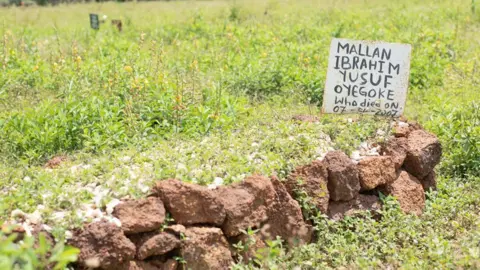 Ifiokabasi Ettang / BBC
Since the BBC’s recent visit to the cemetery, they have seen a dramatic change in fortunes.
The new chairman of the local council, whose office runs the site, decided to put them on the payroll.
“They deserve it, given the enormous amount of work they do every day,” Ryan Hussain told the BBC.
“Graves are the last homes for all of us and people who do this kind of hard work deserve to be paid, so my office will pay them while I’m chairman.”
Magaji confirms that staff have started receiving a monthly salary for the first time:
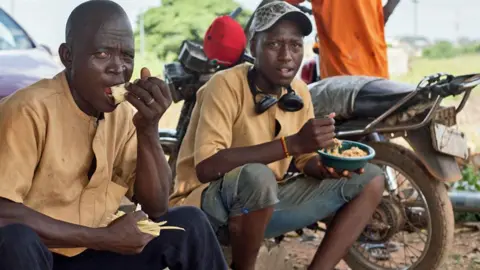 Ifiokabasi Ettang / BBC
This is well below the national minimum wage of $45 a month, but Mr Hussain says he hopes to increase their allowance “over time”.
He says it is a shame the cemetery has been neglected for years by previous local council chiefs.
He plans to repair parts of the fence, install solar lights and add security, the chairman added.
“I am also building a room in the cemetery where corpses can be washed and prepared for burials, previously all this had to be done from the homes.”
For the Abdullahi family, it’s all a welcome investment – and Magaji hopes it will ensure one of his 23 children will one day become a cemetery caretaker.
 Getty Images/BBC


