Physical Address
304 North Cardinal St.
Dorchester Center, MA 02124
Physical Address
304 North Cardinal St.
Dorchester Center, MA 02124

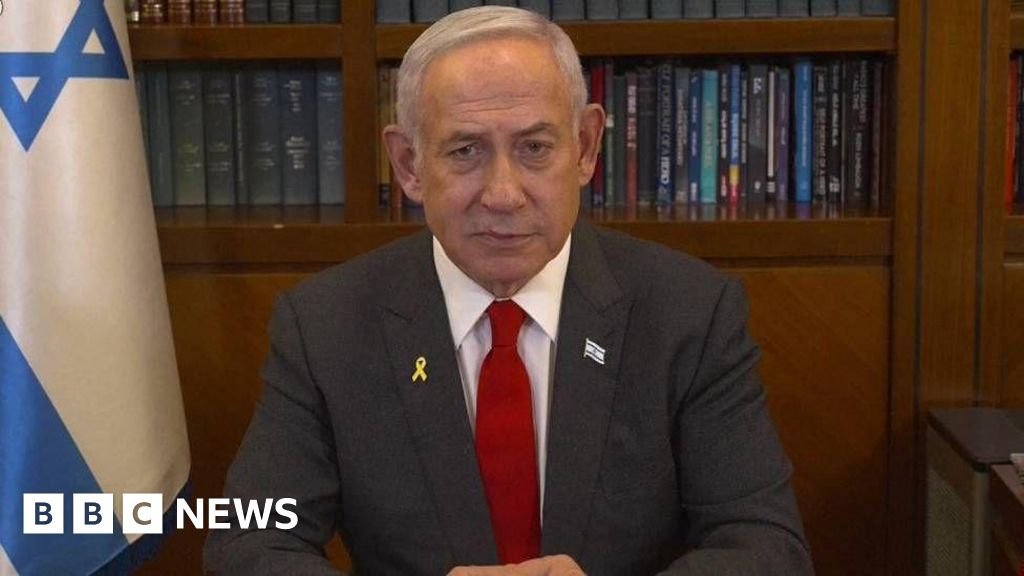
 The office of the Israeli Prime Minister
Israeli Prime Minister Benjamin Netanyahu has said his country is ready to renew the war against Hamas if talks on a second phase of the ceasefire fail.
In a televised speech just hours before it began on Sunday, Netanyahu stressed that the ceasefire was “temporary” and Israel reserved the right to resume strikes on Gaza – and had the support of US President-elect Donald Trump to do so.
Netanyahu also outlined what he called the success of Israel’s military campaign over the past 15 months – including the assassination of Hamas leader Yahya Sinwar.
“We have changed the face of the Middle East,” Netanyahu said, before adding that Hamas was now “all alone.”
The ceasefire is due to take effect at 08:30 local time (06:30 GMT).
Before Saturday’s speech, Netanyahu said Israel would not implement the deal until it received the list of hostages to be released from Hamas.
“Israel will not tolerate violations of the agreement,” he said.
A longer list of the 33 hostages to be released by Hamas has already been published by Israeli media, but has not been confirmed by officials.
But Israeli officials say they have not yet received the names of the three hostages who are due to be released on Sunday.
Meanwhile, Israel has continued airstrikes on what it says are Hamas and Islamic Jihad targets in Gaza – more than 120 people have been killed since the deal was announced on Wednesday, Hamas officials said.
In the next few weeks, the 33 hostages will be released in exchange for 1,890 Palestinian prisoners. Under the terms of the agreement, Israel will also begin withdrawing its forces from Gaza.
It is not clear where the first hostages will be handed over. A senior Israeli military official said three reception points were prepared near the border in northern, central and southern Gaza.
Earlier, a source close to Hamas told AFP that the first three hostages to be freed would be women.
 Getty Images
Talks on the terms of the second phase of the ceasefire are due to begin on the 16th day of the first phase and will focus on achieving a “permanent end to the war”.
Details of the second phase of the deal are still uncertain, but the remaining hostages, including men, are expected to be released at this stage as more Palestinian prisoners held in Israeli prisons are released.
There will also be a complete withdrawal of Israeli troops from Gaza. It is also understood that Hamas police – who will be unarmed unless absolutely necessary – will manage the return of hundreds of thousands of displaced Palestinians to northern Gaza
The third and final stage will involve the rebuilding of Gaza – something that could take many years – and the return of all the remaining bodies of hostages.
on friday night Israel’s government approved the ceasefire and hostage release deal after hours of discussions.
Two far-right cabinet ministers voted against, including National Security Minister Itamar Ben-Gvir.
The drawn-out structure of the agreement is also causing concern and division among the families of the hostages. Some fear that their relatives will be left behind in Gaza after the first phase ends.
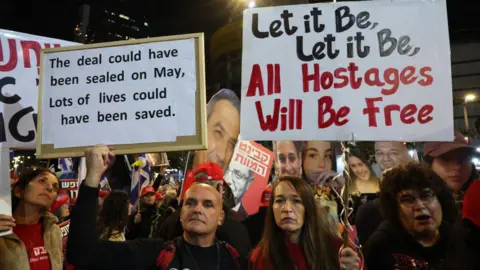
On Saturday night, thousands of protesters gathered in Tel Aviv to demand that the government guarantee the release of more hostages by complying with the first phase of the ceasefire.
Gal Alkalay, a member of the Forum of Hostages and Missing Families, told Reuters: “We could have saved the lives of 200 soldiers and more than 10 hostages.” She added that people died needlessly because the government “couldn’t make a decision and was waiting for Trump.”
 Reuters
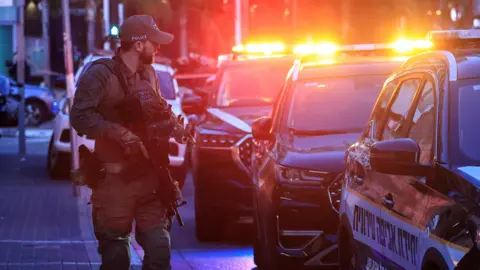
Earlier on Saturday, several people were injured in a knife attack near a restaurant in Tel Aviv, Israeli police said. The attacker was reportedly shot and killed on the spot by a civilian.
The suspect came to Tel Aviv “illegally” from Tulkarm in the occupied West Bank, Israeli media reported.
 Getty Images
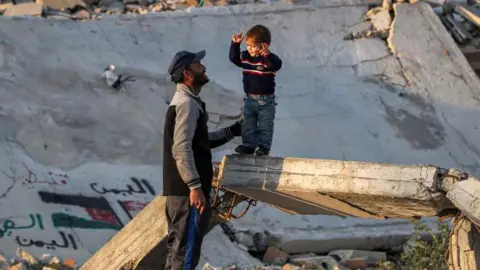
There has been no respite for Palestinians on the ground in Gaza since the cease-fire agreement was announced on Wednesday evening.
The Palestinian Health Ministry said 123 people – including dozens of women and children – have been killed in strikes since then.
On Saturday, the Hamas-run Gaza Civil Defense Rescue Agency said at least five members of a family were killed when a strike hit their tent in Khan Younis, southern Gaza, AFP reported.
As of Thursday afternoon, the Israeli military said it had struck 100 Hamas and Islamic Jihad fighters who were among several “terrorist targets” struck in Gaza, according to Reuters.
The Israeli military launched a campaign to destroy Hamas – which is banned as a terrorist organization by Israel, the US and others – in response to an unprecedented cross-border attack on October 7, 2023, in which around 1,200 people were killed and 251 taken hostage.
Some 46,899 people have been killed in Gaza since then, according to the Hamas-ruled territory’s health ministry. Most of the 2.3 million people have also been displaced, with widespread destruction and severe shortages of food, fuel, medicine and shelter due to the struggle to get aid to those in need.



