Physical Address
304 North Cardinal St.
Dorchester Center, MA 02124
Physical Address
304 North Cardinal St.
Dorchester Center, MA 02124

 Reuters
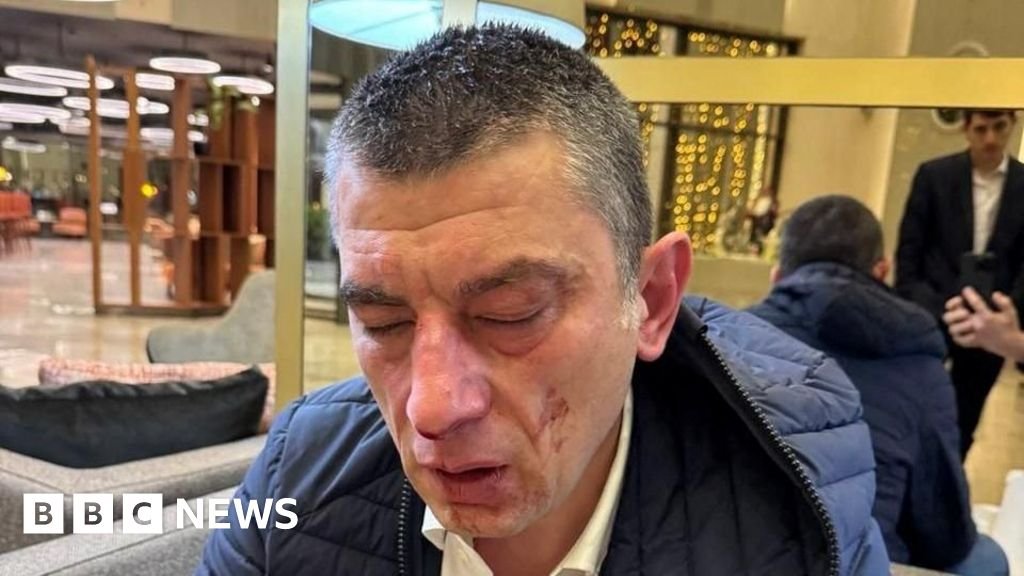
Georgia’s former prime minister and opposition party leader Giorgia Gakharia has been treated in hospital after being attacked in a hotel, reportedly by members of the ruling Georgian Dream party.
Gakharia is said to have suffered a broken nose in the incident in Batumi on the Black Sea coast. His party said it was “politically motivated” and aimed at intimidating the opposition.
The South Caucasus country has experienced political turmoil and repeated attacks on opposition figures and protesters in the months since Georgia’s disputed election in late October.
Protests have been held every night since Georgian Dream leaders announced a month later that they were freezing the issue of opening negotiations to join the European Union.
Hundreds of businesses took part in a three-hour strike on Wednesday, the 49th consecutive day of protests.
Video footage of the incident late Tuesday night in the lobby of the Sheraton Hotel in Batumi was not clear, although Gaharia could be seen being forced to the floor by a group of men. Images later show him with blood on his shirt.
Georgia Gaharia posted on social media Wednesday morning that “I’m doing fine,” but the doctor treating him said he broke a bone in his nose and had a concussion.
European Commission spokeswoman Anitta Hipper said the “reported involvement of Georgian Dream politicians in the brutal attack” was shocking and there was no place for violence or impunity in any democracy.
Georgian Dream figures, however, accused Gakharia of instigating the clash himself. Lawmaker Levan Machavariani told reporters that everything was clear from the footage, while Tbilisi Mayor Kakha Kaladze said the opposition’s agenda was based on lies and deception.
A Georgian Dream MP and other party members have been linked to the attack, which came shortly after Zviad Koridze, a journalist and regional head of the anti-corruption organization Transparency International, was also attacked.
Koridze was visiting Batumi to cover the trial of a leading media figure, Mzia Amaglobeli, the founder of the independent online publications Netgazeti and Batumelebi.
She was held in custody in the Black Sea city on Tuesday, two days after her arrest during a heated argument with a police officer in which she is accused of slapping the officer. A cameraman was also arrested.
The UK ambassador to Georgia, Gareth Ward, said the development of the political crisis in recent days was “extremely worrying”. “The renewed violence against opposition politicians and the arbitrary detention of journalists and protesters is unacceptable,” he said.
Gaharia is not the first opposition leader to face violence in recent weeks. Nika Gvaramiya, who heads the Coalition for Change, was knocked to the ground unconscious when he was detained in the capital Tbilisi last month.
Dozens of Georgian journalists and protesters were also attacked and injured by pro-government thugs during the overnight protests.
Georgian Dream has been accused by the EU and the US of backing away from democracy, and opposition groups accuse the party and its founder, billionaire Bidzina Ivanishvili, of pursuing Russian interests, while the vast majority of Georgians want to join the EU.
Georgi Gakharia was a leading member of Georgian Dream until 2021, serving as interior minister and then prime minister before forming his own opposition party For Georgia.
In a statement, Georgia’s ombudsman Levan Yoseliani condemned the attacks on Gakharia and Zviad Koridze. He called for an immediate reaction “so as not to incite attacks against politicians and journalists”.
Gaharia’s party was one of four opposition groups that secured seats in the October election, but they all refused to take their seats, accusing the ruling party of vote manipulation.
The European Parliament has called for a re-run of the elections, calling them neither free nor fair, and EU foreign policy chief Kaia Callas has accused the government of using repression against the opposition.



